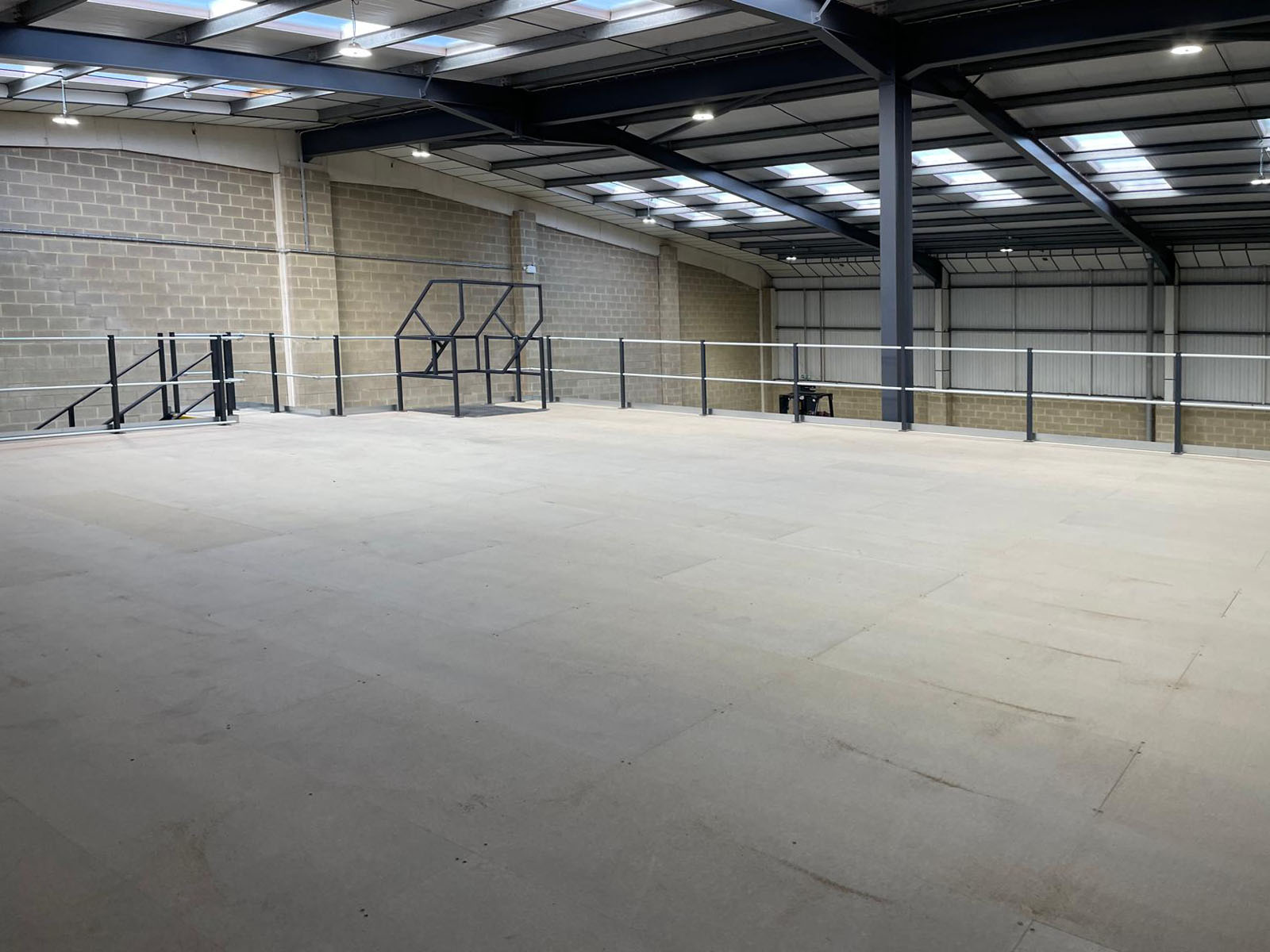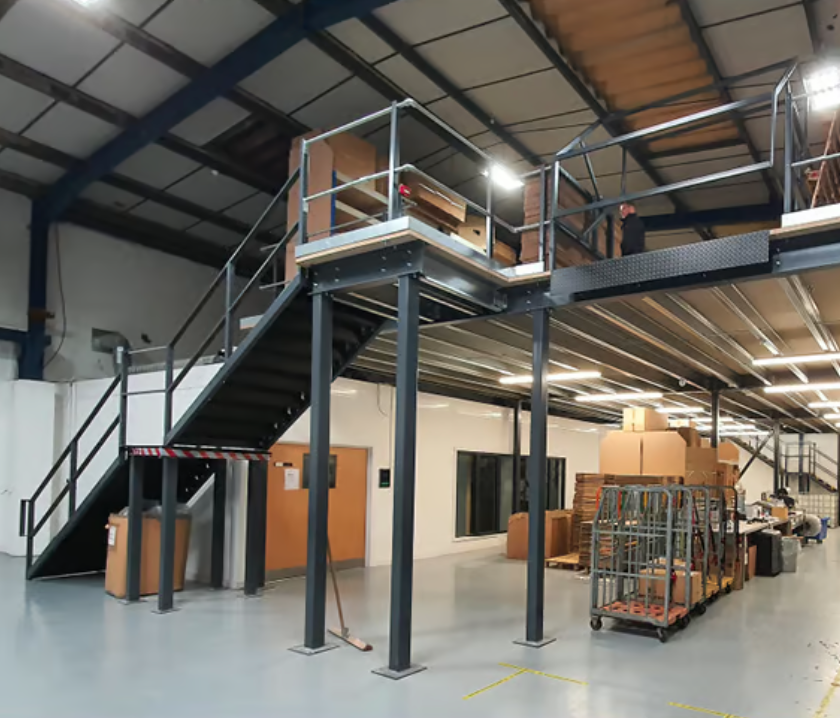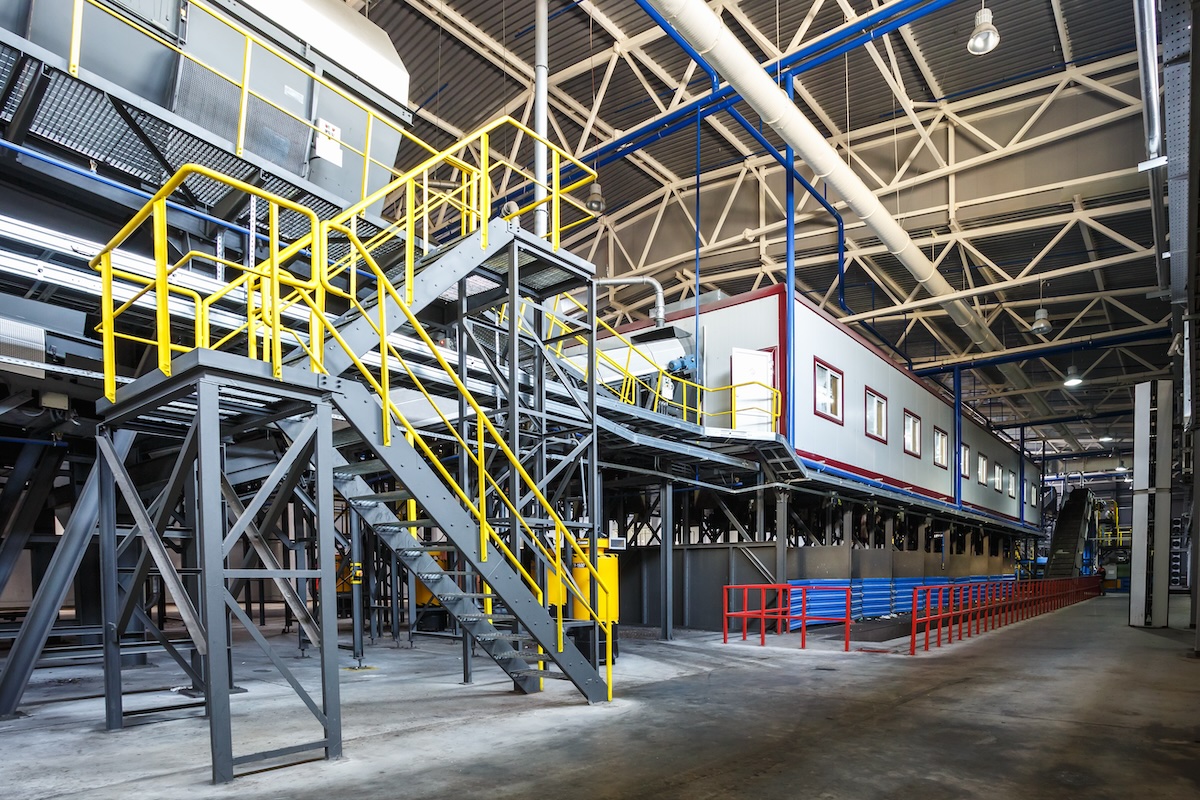
Ask how much weight a mezzanine floor can hold, and the honest answer is: it depends. Not the most satisfying response, but an accurate one. Mezzanine floor load capacity is not a fixed number that applies to every structure, it’s a calculated figure based on how your floor will be used, how it’s been designed, and what standards it should meet.
The good news is that understanding the basics doesn’t require a structural engineering degree. Whether you’re planning a new mezzanine floor, reviewing an existing one or considering a change of use, here’s what you need to know.
What Is Mezzanine Floor Load Capacity?
Load capacity refers to the maximum weight a mezzanine structure can safely support without risk of damage or structural failure. In the UK, it’s typically shown in kilonewtons per square metre (kN/m²) or kilograms per square metre (kg/m²). The conversion is straightforward: 1 kN/m² is equivalent to approximately 100 kg/m².
When structural engineers calculate load capacity, they work with two distinct types of loads:
Dead Loads (Static Loads)
Dead loads are the permanent, fixed weights that the structure carries at all times. This includes things like steelwork, decking, any fixed machinery and other permanent components. These do not change from day to day.
Live Loads (Imposed Loads)
Live loads are the variable, moveable weights such as people, stock, pallet trucks, forklift traffic and temporary equipment. Because live loads shift and move during normal use, they are often the more demanding part of the calculation and the most important to get right.
The total load capacity combines both figures, with your structural engineer applying safety margins on top of account for real-world working conditions. Those safety margins are not there to give engineers something to argue about. They exist because real operations rarely behave exactly as planned.
What Load Capacity Does Your Mezzanine Need?
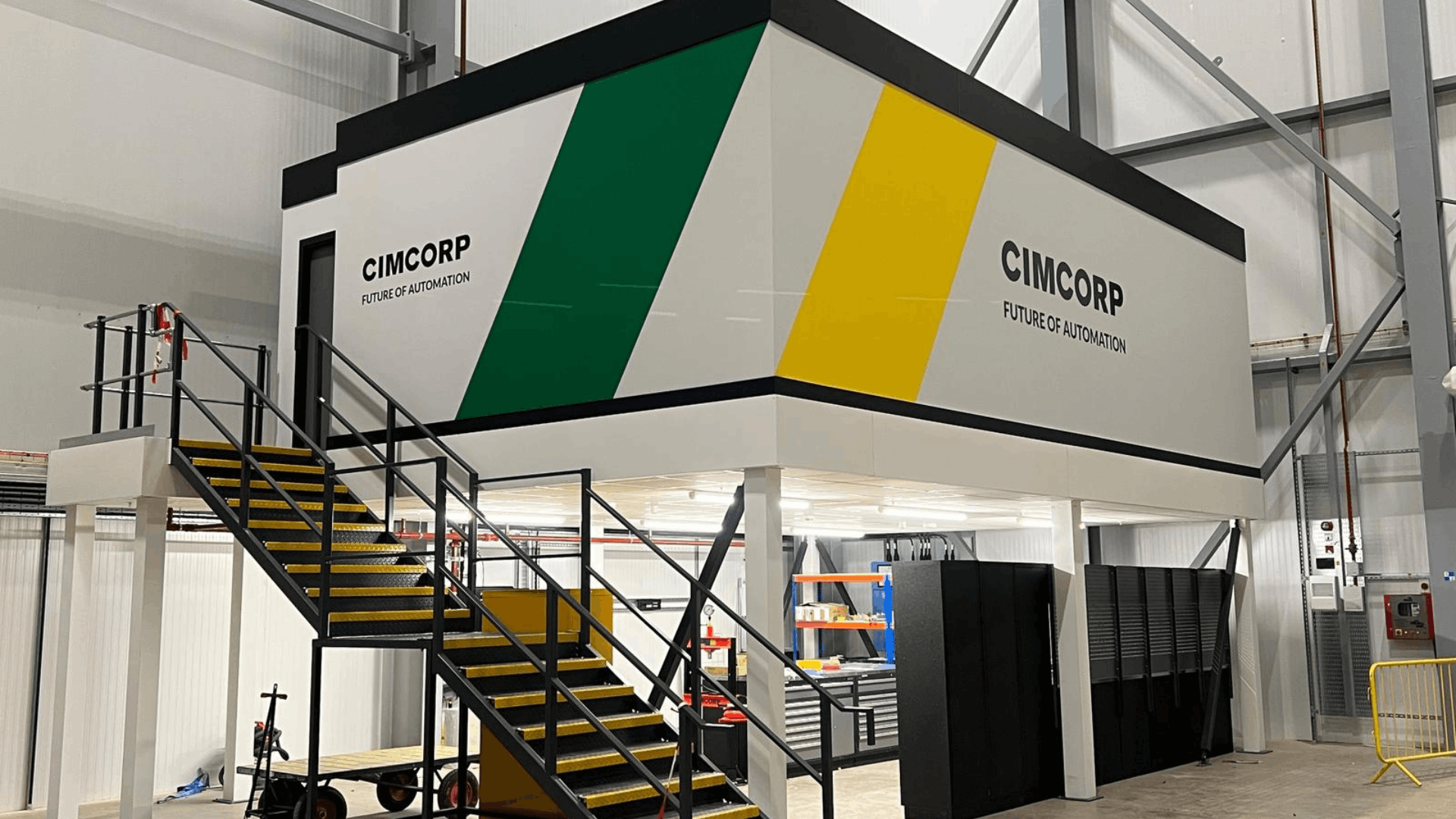
The right load capacity depends on how your mezzanine will be used. Here are the typical figures used across the UK industry, based on BS 6399-1:1996 (Loading for Buildings) and current building practice:
- Office mezzanine — 3.0 to 3.5 kN/m² (approximately 300–350 kg/m²)
- Retail mezzanine — around 4.0 kN/m² (approximately 400 kg/m²)
- Light storage — 4.8 kN/m² (approximately 480 kg/m²)
- Medium storage — 5.0 to 7.2 kN/m² (approximately 500–720 kg/m²)
- Heavy storage and industrial mezzanines — 7.2 to 10.0 kN/m² (approximately 720–1,000 kg/m²)
- Specialist industrial — above 10 kN/m², in some cases exceeding 4,000 kg/m²
While approx. 80% of our work focuses mainly on office, retail and light/medium storage mezzanine floors, we’ve been in the business for over 15 years and have the capability to take on heavy storage and specialist industrial mezzanine floors, too.
These are starting points, not guarantees. Your actual requirement will be confirmed during the design and survey stage, based on your specific operations, the materials being stored or processed, and any machinery involved.
One piece of practical advice worth highlighting: if your usage could realistically increase or change over time, build in extra capacity from the outset. Upgrading a mezzanine’s load rating after construction is possible, but it is significantly more disruptive and expensive than getting it right first time.
Factors That Affect Load Capacity
Intended Use
The primary driver of load capacity is what the floor will actually be used for. An office mezzanine with desks and people has very different demands compared to a warehouse mezzanine handling palletised goods. The same logic applies across the full range of applications: industrial mezzanine floors supporting production lines or heavy plant, storage mezzanines loaded with racking and shelving, retail mezzanine floors dealing with high foot traffic, and factory mezzanines where heavy equipment sits in fixed positions for extended periods. Each application has its own load profile, and each needs to be designed accordingly.
Dynamic Loads and Vibration
For industrial and warehouse environments, the weight of goods is only part of the picture. Forklift trucks, pallet trucks, conveyors, and heavy machinery all create dynamic loads and moving forces that generate vibration and deflection in a structure. A mezzanine used for active production or pick-and-pack operations must be designed with these dynamic effects factored in, not just the static weight of whatever ends up sitting on it.
Concentrated Loads
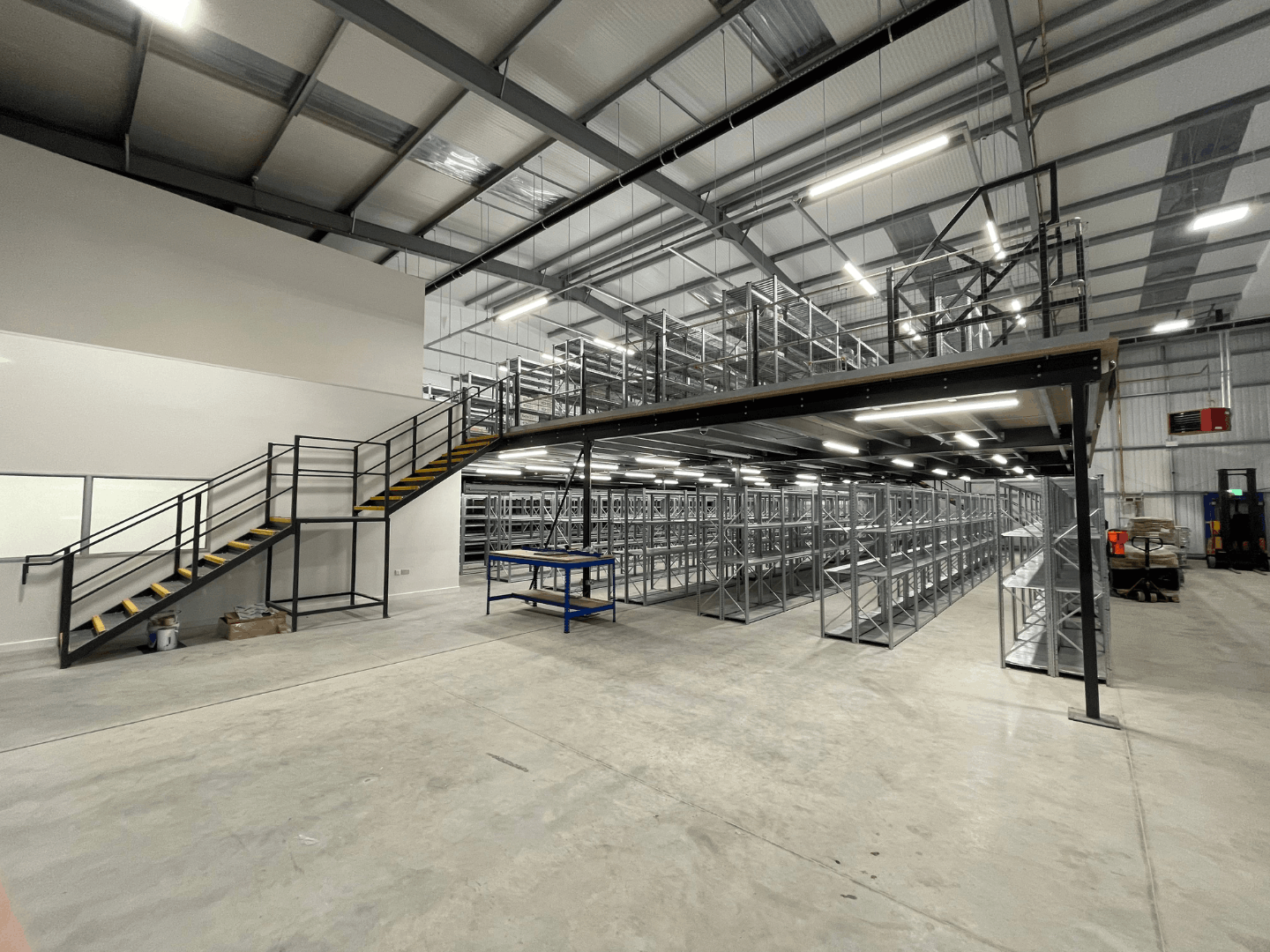
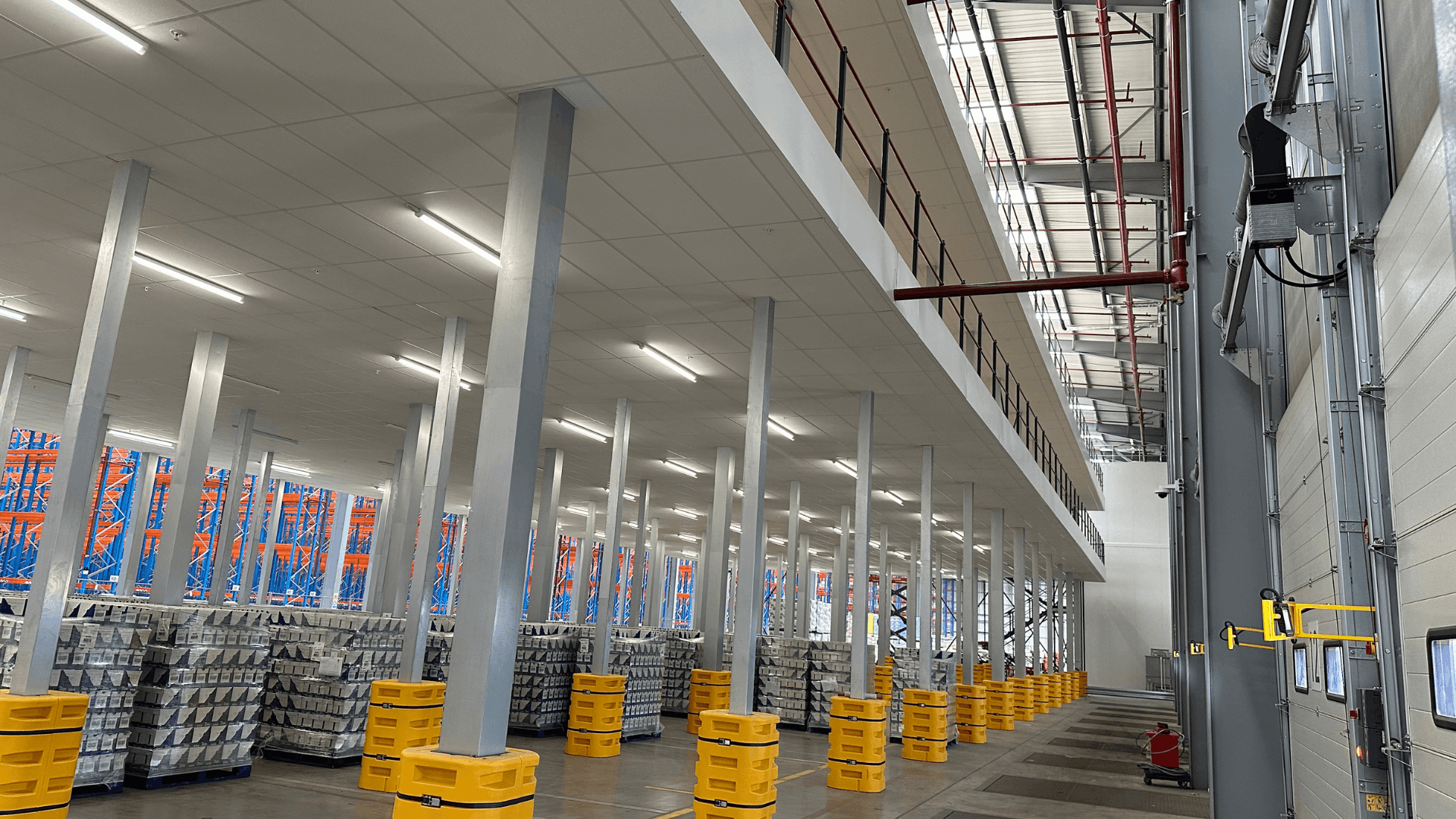
Racking and shelving are effective ways to maximise storage, but they create an important challenge: rather than distributing weight evenly across the floor, they concentrate it onto small contact points… the legs of the racking. In demanding storage environments, this can mean several tonnes bearing down on a very small area.
Where concentrated loads are a concern, spreader plates are used to distribute the weight more evenly across the decking and structural beams below. Getting this detail right at the design stage is far easier than retrofitting it later.
Staircases
It is surprisingly easy to focus entirely on the floor and overlook the staircase. Staircases attached to mezzanines must meet their own load requirements governed by BS 5395 for industrial applications. A staircase that has not been designed to handle the expected traffic and loads is a compliance gap, regardless of how well the main floor has been rated.
Fire Protection
Larger mezzanines, or those used in certain industrial settings, may require specific fire protection measures such as intumescent coatings, fire-rated boards, or sprinkler systems. These requirements can influence structural decisions and need to be accounted for as part of the overall design from the outset.
What the Regulations Say
All mezzanine floors in the UK must comply with the Building Regulations 2010, with Part A covering structural requirements. Load capacity calculations are carried out in accordance with BS 6399-1:1996 (Loading for Buildings) and, increasingly, the Eurocode standard BS EN 1991, which provides updated guidance on imposed loads for buildings.
In practice, any mezzanine built by a reputable company (such as The Mezzanine Company, although we’re certainly not biased!) will go through a full structural design process, receive building regulation approval, and be issued with a completion certificate confirming compliance.
Once installed, the load capacity rating must be clearly displayed on the floor itself. This is not just good housekeeping, it is a regulatory requirement, and it matters every time someone new starts using the space. If a mezzanine was constructed without proper documentation, or if the paperwork has been lost over time, a structural inspection is the right next step rather than continuing to operate the floor without knowing what it is rated for.
What Happens If You Exceed the Load Limit?
Beyond the obvious safety risks, which are serious, operating a mezzanine beyond its rated capacity creates real legal and insurance exposure. If an incident occurs and investigations reveal the floor was being used outside its rated load, the consequences for the business involved can be severe.
This is one of the reasons regular inspections matter. If your operations change, or if you are considering putting the mezzanine to a different use than it was originally designed for, have the structure assessed before making the switch. The rating assigned at installation was specific to the use case at the time. A storage mezzanine rated for light goods is not automatically suitable for heavy plant, and assuming otherwise is a risk nobody should take.
Getting Load Capacity Right from the Start
Getting load capacity right begins at the survey stage. A good mezzanine company will not simply ask what you need and start drawing plans. They will want to understand how the space will function day to day: what will be stored or operated on it, how goods will move on and off it, and what the heaviest realistic load scenario looks like.
That level of detail matters. A floor that is specced correctly from the start is one that will serve your business reliably, comply with building regulations without issue, and avoid requiring expensive modifications when your operations grow.
For existing mezzanines, the same principle applies. If you are unsure of your floor’s rated capacity, particularly if it was installed some years ago or by a company that is no longer trading, get it assessed. The rated capacity should be confirmed, documented, and reviewed whenever your use of the space changes significantly.
Talk to The Mezzanine Company
Whether you are planning a new mezzanine floor from scratch, reviewing an existing structure, or thinking about a change of use, getting load capacity right is not something to approach with guesswork. We design and build mezzanines for businesses across the East Midlands and the wider UK, and load capacity is one of the first things we establish, not an afterthought.
Get in touch via our contact form or call us on 0115 939 7572 to discuss your project.
Get a Free Survey for Your Mezzanine Floor Needs
Whether you need a mezzanine floor for office space, storage space, or use within your industrial environment, we can help! Get in touch with our expert team today for a free quote.