

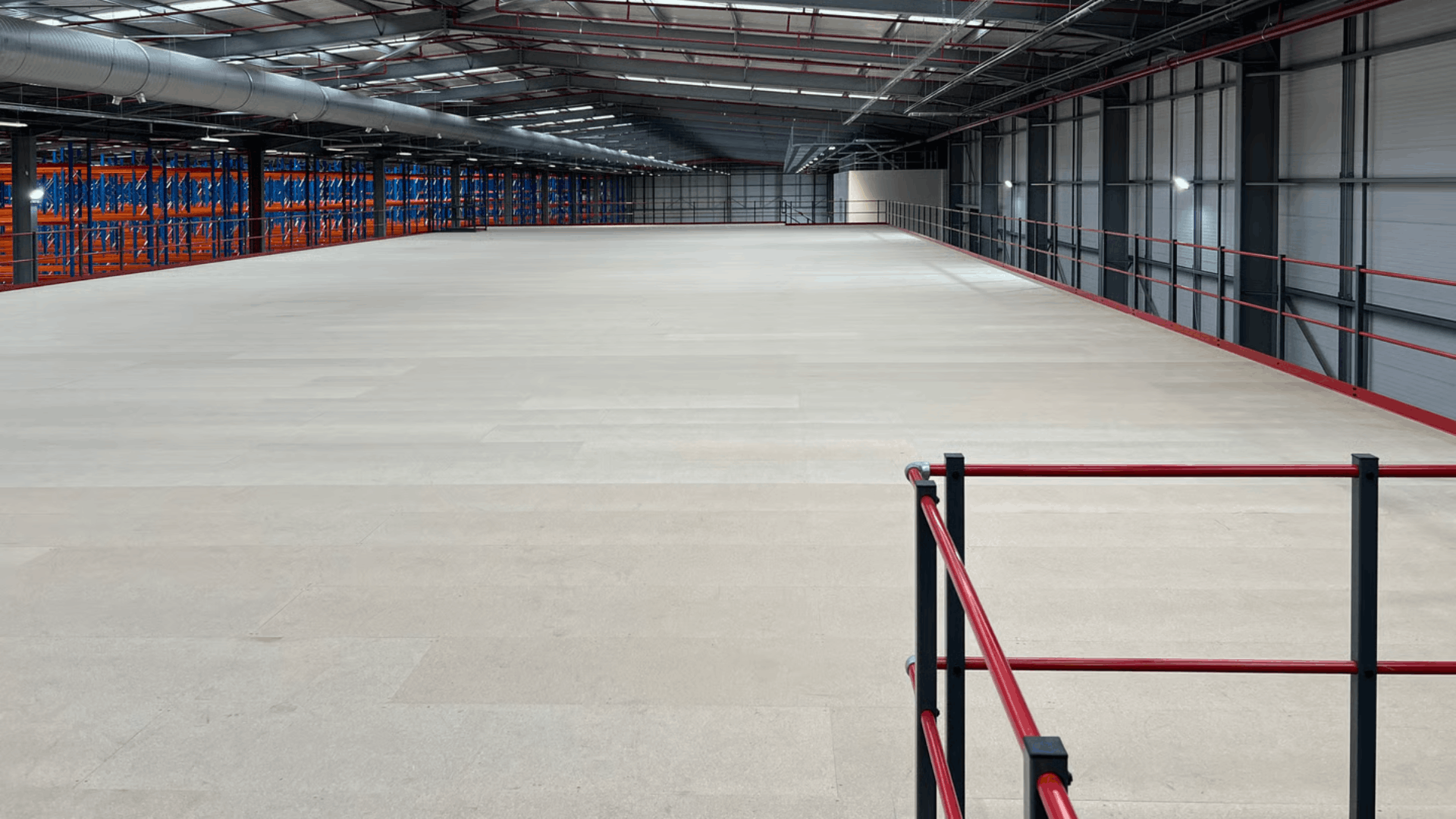
Storage Mezzanine Floors
Streamlined storage solutions for businesses and workplaces without compromising existing floor space



Running Out of Space? Discovery Our Storage Mezzanine Floor Solutions
Not having enough usable floor space is one of the most common challenges facing growing businesses. In most cases, relocating to a larger premises is rarely the most practical or cost-effective solution.
Storage mezzanines offer a smarter alternative, making use of the unused vertical space within your existing building to create a fully structural second level without any change to your footprint or lease.
Our storage mezzanine floors are engineered and installed to meet current Building Regulations, with each structure designed around your building’s specific dimensions, floor loading capacity and intended use.
From initial site survey through to handover, we manage the entire process, including Building Regulations approval, so you can focus on running your business while we take care of the build.
Free Surveys and Space Planning
Trading for Over 15 Years
Fully Accreddited & Insured
In-House Design & Installation Teams
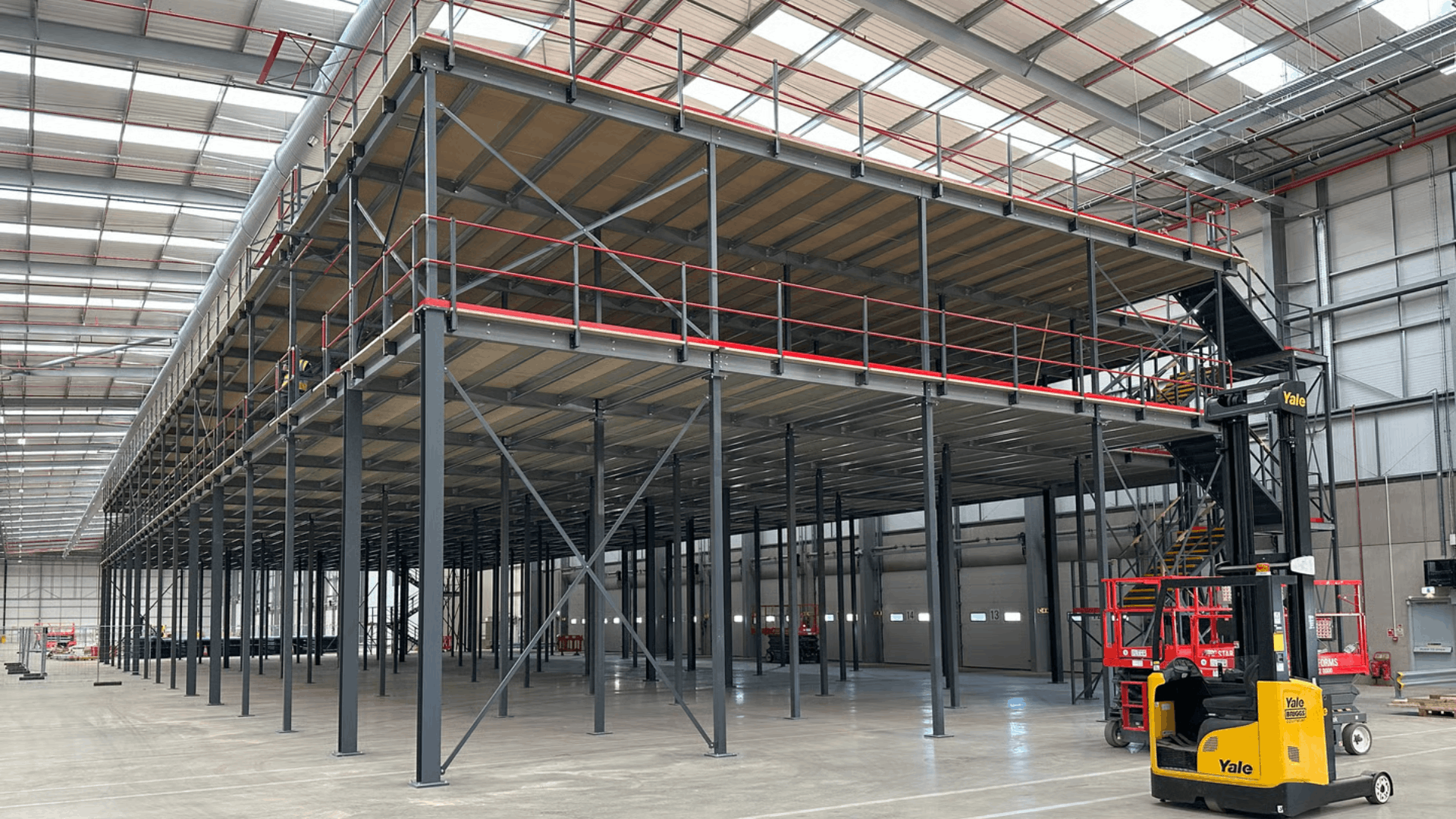
Why Choose Us For Your Mezzanine Floor Project?
| Features | The Mezzanine Company (Us!) | Average Mezzanine Builder | Average Builder |
|---|---|---|---|
| Free Survey & Design | |||
| All Fitters Hold CSCS Cards | |||
| Full Building Control Compliance | |||
| Construction & Loading Calculations | |||
| We Are The Designated Designer For Your Floor | |||
| Building Control Checks | |||
| Professional Indemnity Insurance | |||
| In-House Electrical Works | |||
| In-House Fit Out Team | |||
| Full Scheme Turnkey Service | |||
| Finance Your Mezzanine Floor Over 3-5 Years (Via Our Partners) |
| Consideration | Recommended Storage mezzanine |
Relocating to a larger unit | Building extension | Off-site storage | Rearranging existing layout |
|---|---|---|---|---|---|
| Upfront cost | Moderate | Very high | Very high | Low | Minimal |
| Ongoing cost | None beyond maintenance | Higher lease costs | Higher rates and insurance | Recurring monthly fees | None |
| Space gained | Doubles or triples usable floor area | Depends on new unit | Significant if approved | None on-site | None — same footprint |
| Disruption to operations | Minimal — typically 2 to 5 days | Major — full business move | Significant during build | Low on-site | Temporary |
| Planning permission required | Not usually | Change of use may apply | Yes — full planning application | No | No |
| Building Regulations approval | Yes — managed by installer | Varies by property | Yes — complex process | No | No |
| Timescale to completion | Weeks from survey to install | Months to years | Months to years | Days to arrange | Days |
| Operational efficiency | High — stock and staff on-site | High once settled | High once complete | Low — split site working | Unchanged |
| Relocatable if you move premises | Yes — bolted structure | N/A | No — permanent build | N/A | N/A |
| Can include offices or welfare | Yes — fully fitted out | Depends on new unit | Yes | No | No |
| Investment recovery | Typically within 1 to 3 years | Slow — high ongoing costs | Slow — high upfront cost | No asset created | No asset created |
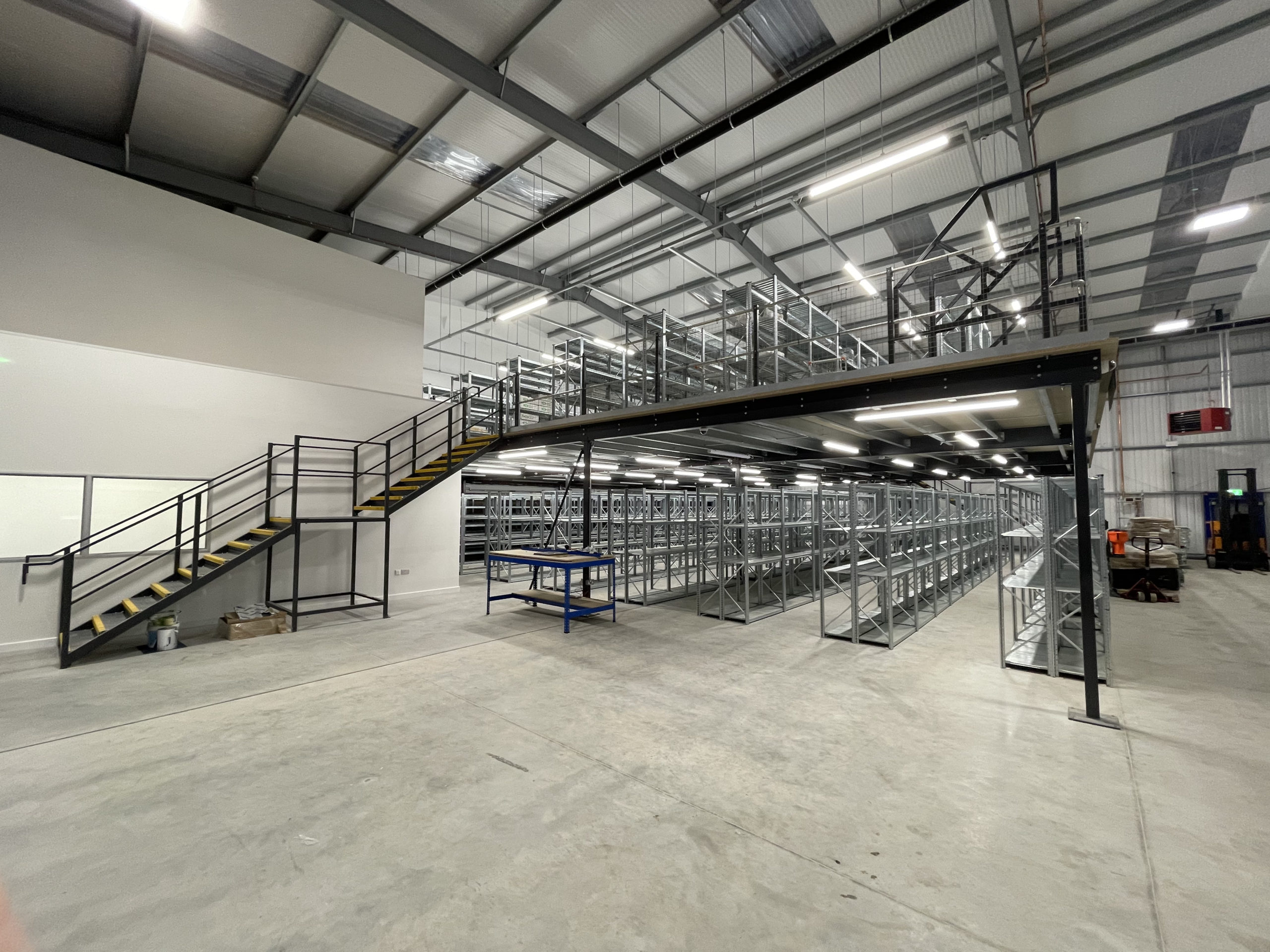
Helping your business stay organised
Storage Mezzanine Floors to Improve Workplace Logistics
Ranging from paperwork to stock, a storage mezzanine is the perfect way to have access to additional storage without the need to buy a new building or invest in external spaces such as units. Many businesses will opt for storage mezzanine floors to help improve their workplace operations and organisation. Businesses may also choose a factory mezzanine floor, warehouse mezzanine floor, or a office mezzanine floor to help with other various storage needs like, storing products or for keeping business paperwork safe within an office.
Trusted by


















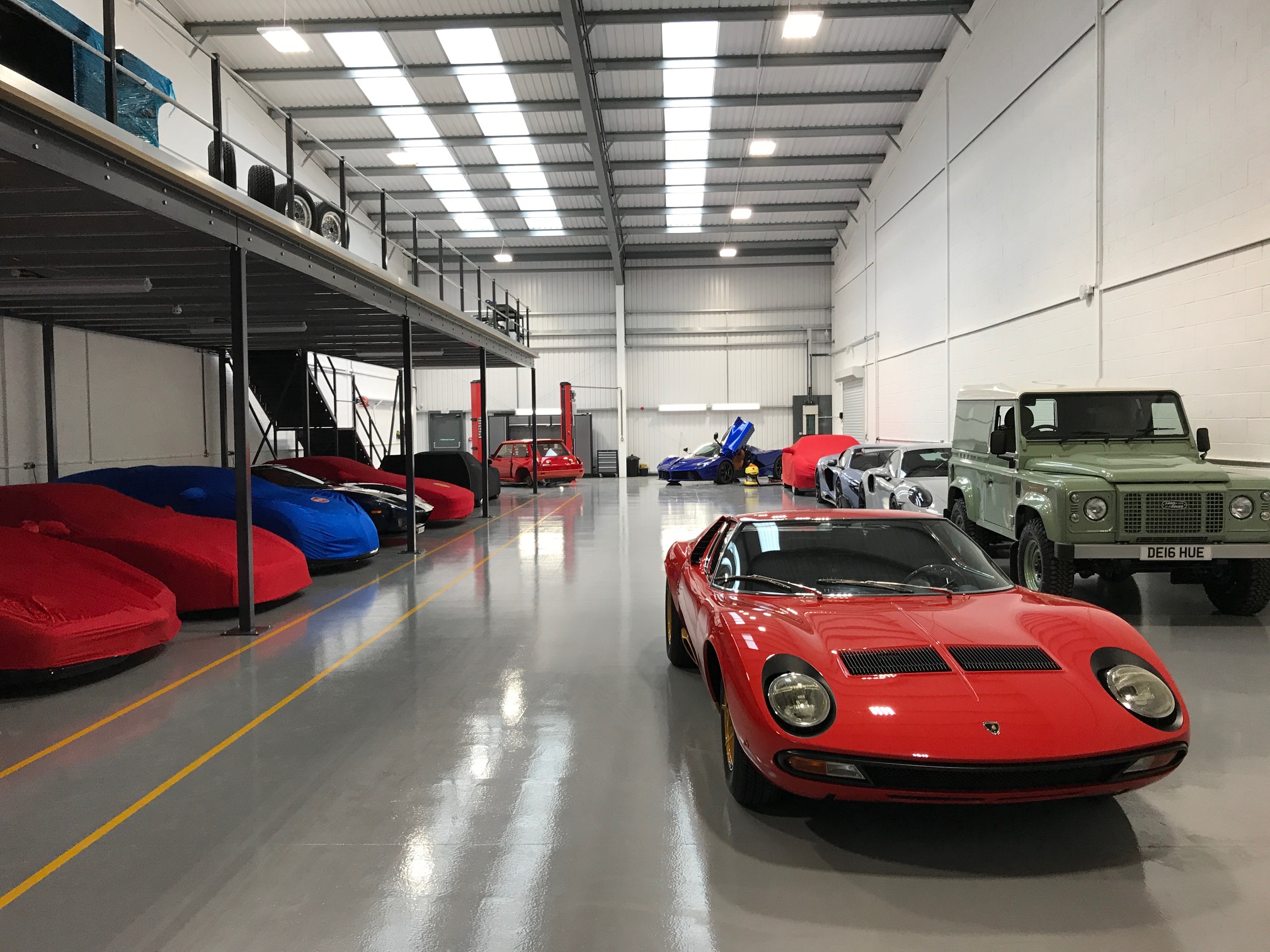
Making the most out of your storage space
Effective Mezzanine Design and Space Management
As well as creating a new floor for things to be stored, we’ll also work with you to ensure that you are making the most out of this space and it is filled with solutions that work for your team and industry. Crafted from durable, sturdy materials, your new mezzanine floor will have the ability to hold machinery, furniture and fixtures, perfect to use within an office. We can also install fire protection features including fire rated flooring.
Find out more about our mezzanine design service.
-
1Survey and Discuss
-
2Detailed Quotation
-
3Design
-
4Install
-
5Handover
Survey and Discuss
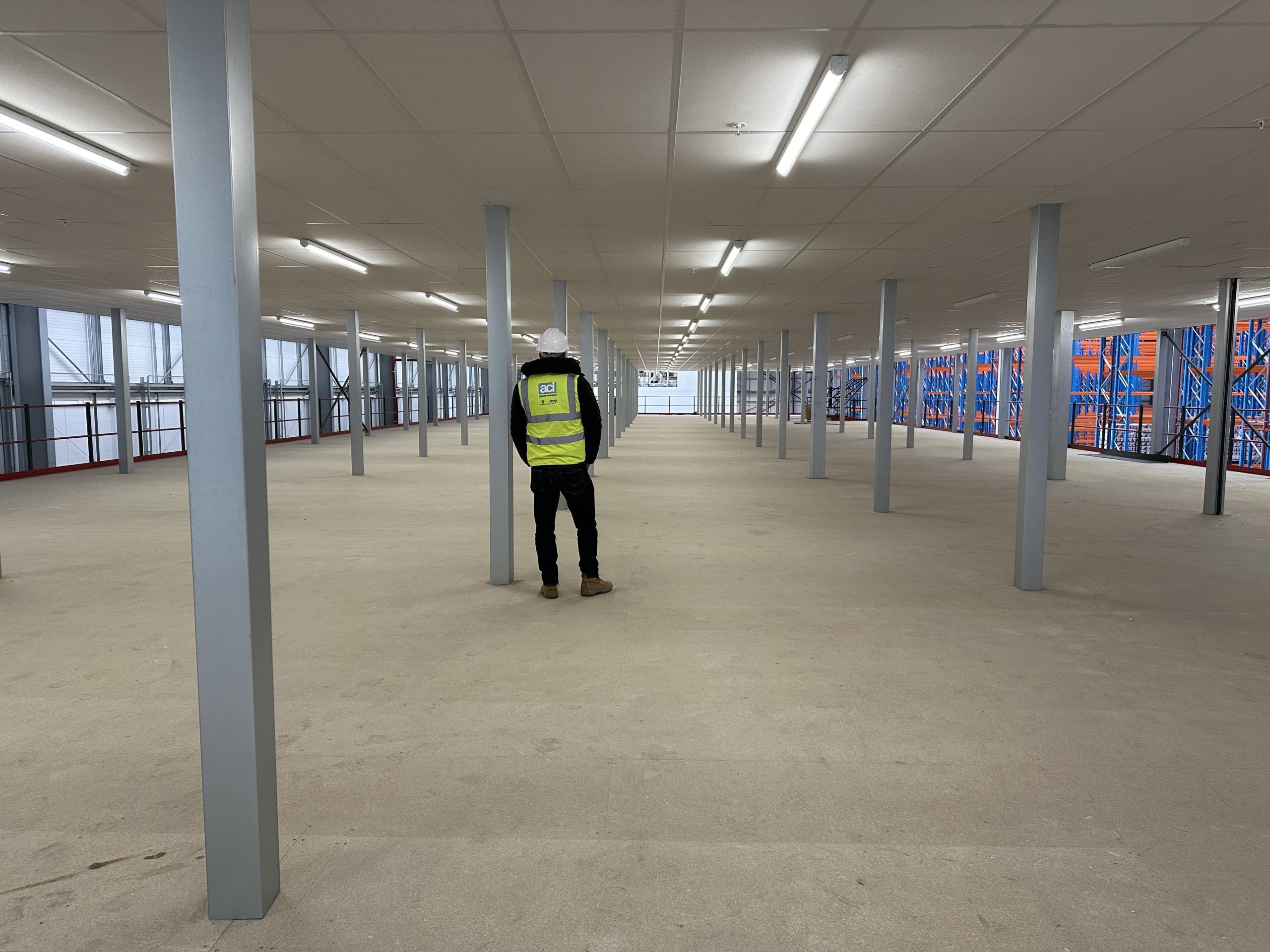
Before any work begins, a member of our team will visit your site to carry out a full survey of your building. We take measurements of your internal clear height, floor loading capacity, column positions and available footprint, and we take the time to understand exactly how you intend to use the space. This initial conversation is just as important as the measurements. Knowing whether your storage mezzanine will carry racking, office space, machinery or a combination of all three allows us to design something that genuinely works for your operation rather than a generic solution dropped into your building.
Storage Mezzanines UK FAQs
If you don’t see your storage mezzanine query below, please give us a call on 0115 939 7572.
How Much Additional Storage Space Can A Mezzanine Floor Give Me?
The additional storage space a mezzanine floor provides depends on your building’s internal clear height, the footprint available for the structure and how the platform will be used once installed.
As a general rule, a mezzanine floor can cover anywhere from a portion of your building to virtually its entire footprint, depending on what needs to remain accessible at ground level. In practical terms, a warehouse with a clear internal height of 6 metres could accommodate a mezzanine at 3 metres, leaving sufficient headroom both below and above the platform for comfortable working and compliant racking. In that scenario, you are effectively doubling your usable floor area within the same four walls.
For businesses using the mezzanine for shelving or long-span racking, the additional capacity can be substantial. A 500 m² mezzanine installed above an existing 500 m² ground floor operation, for example, takes your total usable area to 1,000 m² without any change to your lease or building footprint. Multi-tier mezzanine systems can multiply this further still, and are commonly used in order fulfilment and parts distribution environments where high-density storage is a priority.
The most accurate way to understand what a mezzanine can add to your specific building is to contact us today to carry out a free site survey. They will assess your clear height, floor loading capacity, column positions and access requirements before producing a layout that maximises the usable space on offer.
We’re Running Out Of Warehouse Space But Can’t Afford To Move To A Bigger Unit, So What Are Our Options?
Running out of floor space doesn’t necessarily mean you need to relocate. In many cases, the answer is above you rather than around you. A storage mezzanine floor is a structural steel platform installed within your existing building, effectively creating a second level of usable space without the cost or disruption of moving premises. For businesses operating from warehouses or industrial units with ceiling heights of 4.5 metres or above, a mezzanine can typically double or even triple your usable floor space at a fraction of the cost of a larger lease. Installation is usually completed within a few days, and the structure can be taken with you if you ever do need to relocate.
What Can We Do If We Need A Small On-Site Office But There’s No Room To Build One Without Losing Storage Space?
This is one of the most common reasons businesses invest in a mezzanine floor. An office mezzanine positions your workspace above your operational floor rather than within it, preserving every square metre of ground-level space for storage or production. The mezzanine can be fitted out to include partitioned offices, meeting rooms, WC facilities and air conditioning. In short, an office mezzanine gives you a fully functional workplace without sacrificing any of the floor area below. Planning permission is not usually required for internal mezzanine structures, though your installer will confirm this based on your specific building and use.
We’re Taking On More Stock, But Our Racking Is Already At Capacity, So Do We Need A Bigger Warehouse?
Not necessarily. If your racking has reached its limit but your building still has clear height above it, a mezzanine floor with integrated racking or shelving is a practical alternative to upsizing your premises. A multi-tier mezzanine system can be designed to work alongside or above your existing racking layout, giving you additional pick faces and storage positions without any change to your lease. This approach is widely used in fulfilment, wholesale and manufacturing environments where stock volumes grow faster than floor space allows.
Does A Storage Mezzanine Floor Require Planning Permission?
In most cases, a mezzanine floor installed inside an existing commercial building does not require planning permission, as it typically falls within permitted development rights. However, Building Regulations approval is required in England and Wales to ensure the structure meets fire safety, structural integrity and means of escape requirements. Your mezzanine supplier should manage the Building Regulations process on your behalf and provide all relevant documentation on completion. If your building is listed or sits within a protected area, your supplier will advise you on any additional requirements.
How Long Does It Take To Install A Mezzanine Floor?
Installation timescales vary depending on the size and complexity of the structure, but most standard storage mezzanines are installed within two to five working days. Larger multi-tier systems or those with integrated staircases, offices or conveyors may take a few weeks.
At The Mezzanine Company, we can provide you with a more accurate idea of the timeframes applicable to your project once we know your requirements. Please get in touch to discuss your needs with us.
Can A Mezzanine Floor Be Relocated Or Extended If We Move Premises Or Expand?
Yes. This sense of flexibility is one of the key commercial advantages of a mezzanine floor over a permanent structural extension. Mezzanine systems are bolted rather than welded, which means they can be dismantled, transported and reassembled in a new location. Extensions to existing structures are also straightforward in most cases, providing the original design allowed for future growth. If you anticipate expanding in the medium term, it is worth discussing this with your supplier at the outset so the initial structure can be designed to accommodate it efficiently.
What Is The Difference Between A Storage Mezzanine And A Structural Mezzanine?
The terms are sometimes used interchangeably, but there is a meaningful distinction. A storage mezzanine is designed primarily to carry shelving, racking or palletised goods and is specified accordingly. A structural mezzanine is engineered to higher loads and may support heavy plant, production machinery or vehicles, and typically requires more substantial steelwork and foundations. Both types are subject to Building Regulations and must be designed by a qualified structural engineer. When requesting a quote, be specific about the intended use and the heaviest loads the platform will need to support so the correct specification is produced from the outset.