Most businesses reach the same crossroads sooner or later. The stock no longer fits, the team has outgrown the office, or the shop floor is fighting the stockroom for space. The instinct is to assume there are only two ways out: take on a bigger building or bolt an extension onto the one you have. Both are expensive, both are slow, and both ignore the space you are almost certainly already paying for, which is the empty height above your head.
That is where a mezzanine floor comes in. If you have been told one might solve your space problem and you want to understand exactly what you would be getting, this guide walks through what a mezzanine floor is, what they are used for, what they cost in the UK, and the rules you need to know before you build one.
In short, a mezzanine floor is an intermediate level built inside an existing building that turns unused vertical space into usable floor area, without changing the footprint of the building or requiring you to move.
What is a mezzanine floor?
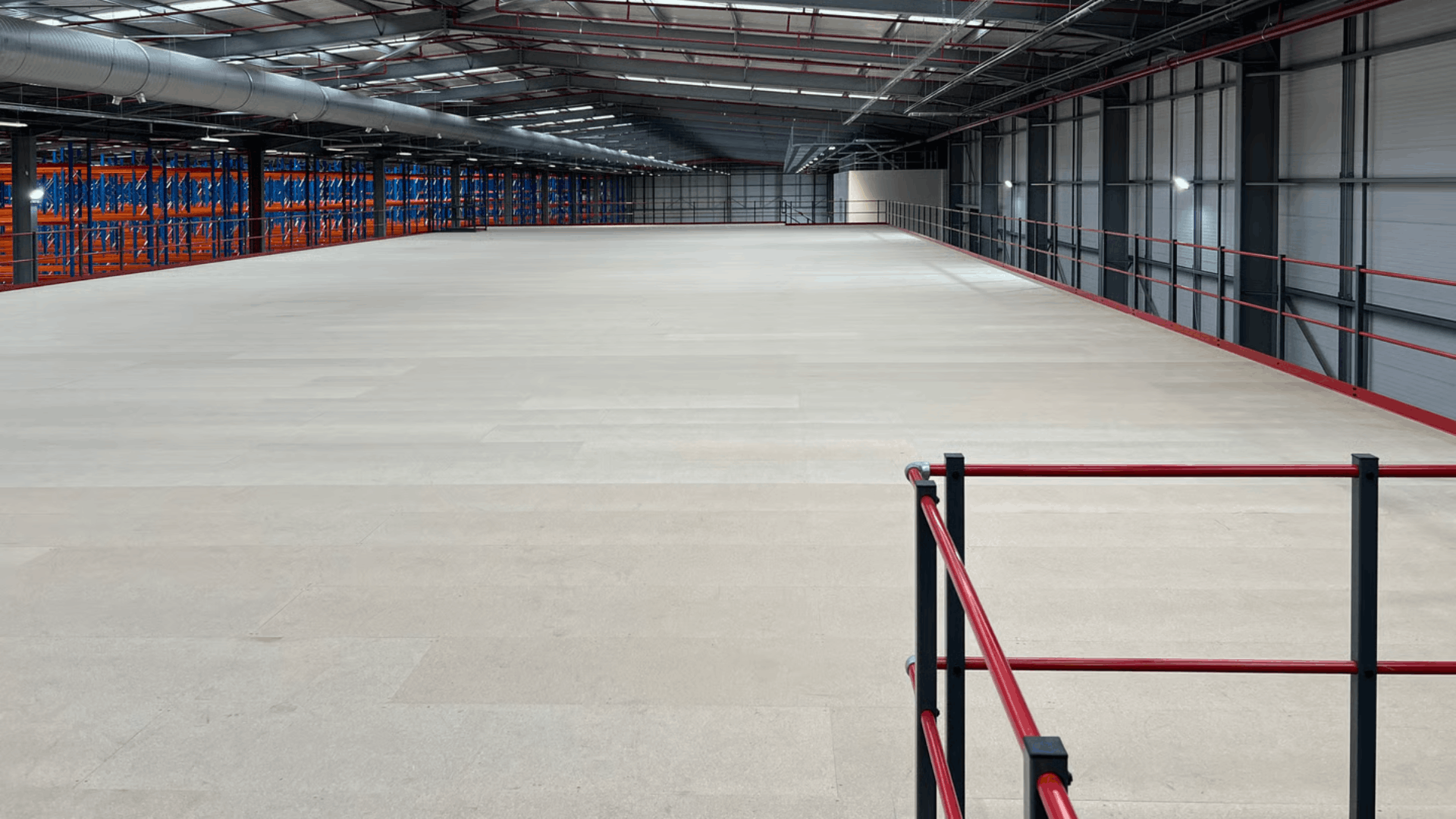
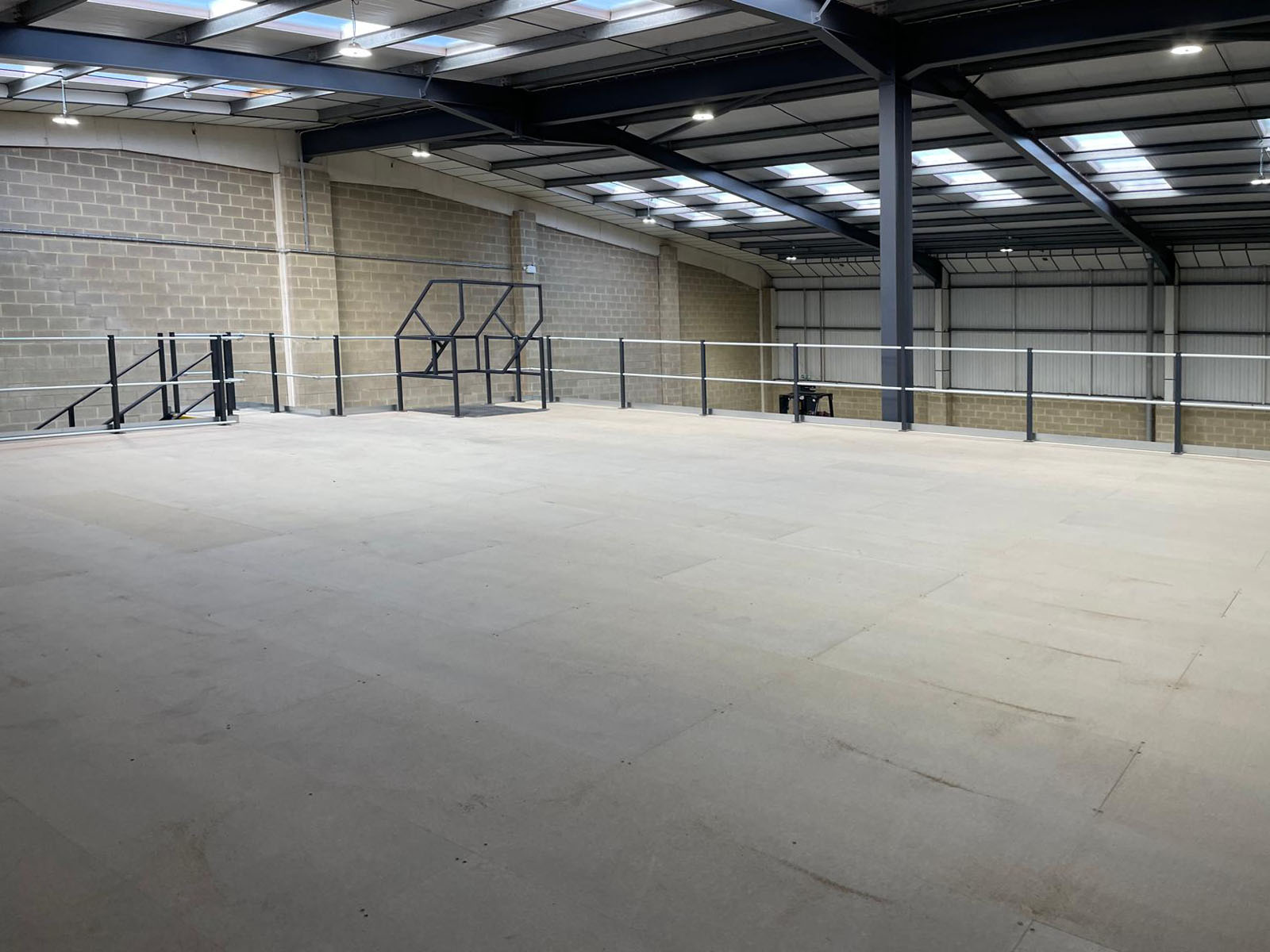
A mezzanine floor is a raised platform installed between the main floor and the roof of a building, creating an extra level in the space that would otherwise sit empty. The word comes from the Italian “mezzano”, meaning middle, which is exactly what it is: a middle floor that sits above the ground level but below the ceiling.
A few things make a mezzanine different from simply adding a storey to a building. It is usually freestanding, which means it is supported by its own steel columns and beams rather than relying on the walls of the building. It is self-contained, so in most cases it can be altered, extended or even dismantled and relocated later. And because it does not normally count as an additional storey in planning terms, it is a far simpler way to add space than a conventional building extension.
The principle is straightforward. Most commercial and industrial units have generous height that goes completely unused. A mezzanine takes that vertical space and gives you a second working level, so you expand upwards instead of outwards. For a growing business that has run out of room, it is often the difference between staying put and going through the cost and upheaval of a warehouse relocation.
How does a mezzanine floor work?
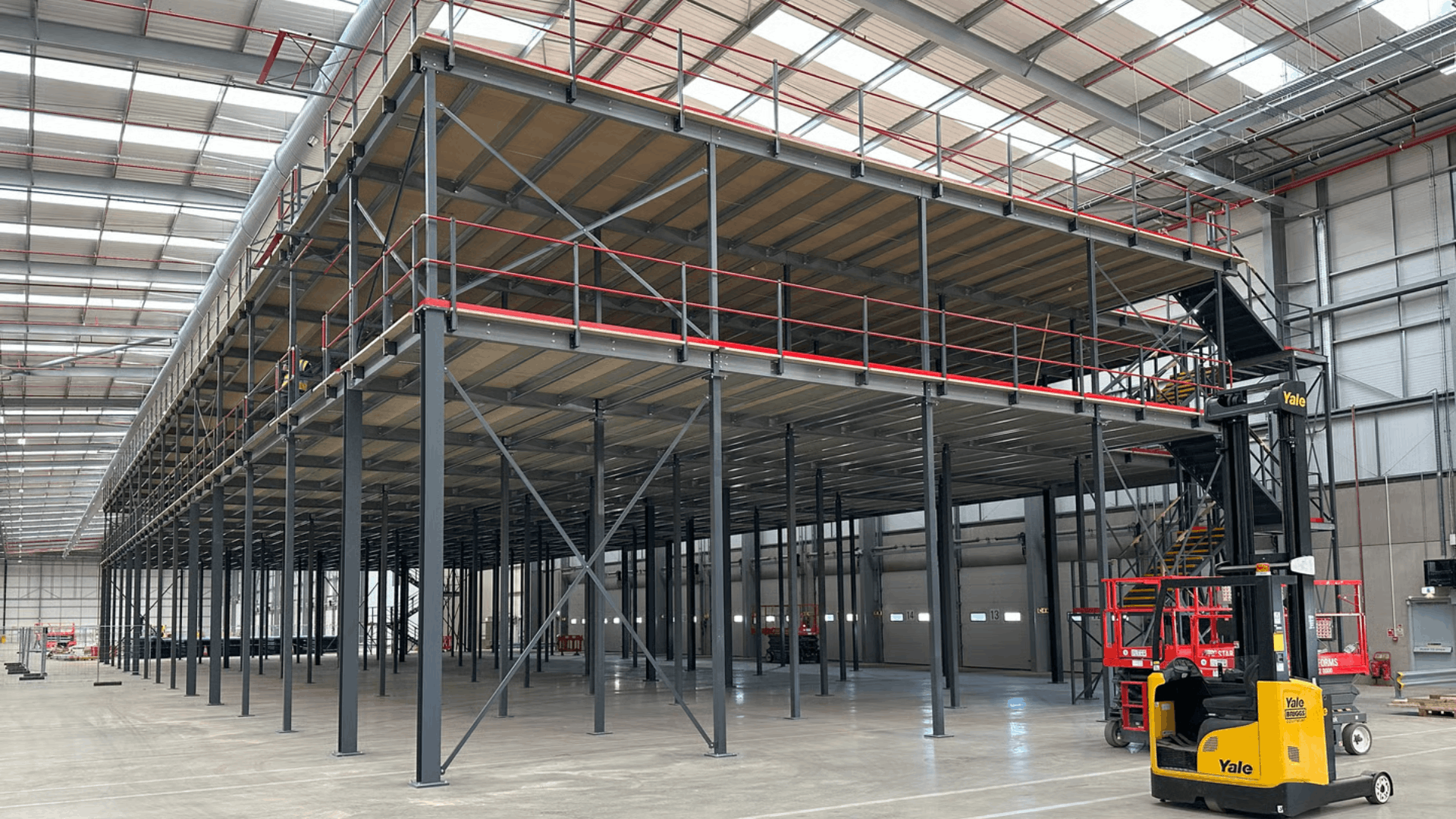
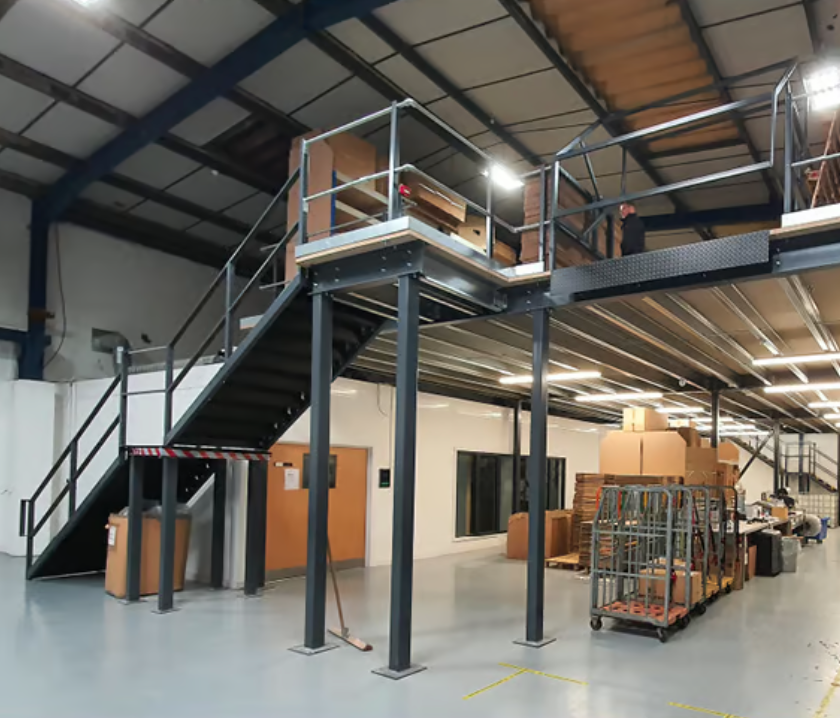
It helps to know what you are actually buying, because a mezzanine is more than just a raised deck. A typical freestanding mezzanine floor is made up of a handful of core parts:
- Steel columns: Vertical supports that carry the weight of the structure down to the ground floor slab. Where they land matters, because they shape how you use the space below.
- Primary and secondary beams: The steel framework that spans between the columns and carries the floor above. Wider spaces between columns need heavier beams, which affects cost.
- Decking: The floor surface itself. Chipboard is common for offices and lighter use, while steel chequer plate is the usual choice for industrial and storage settings where durability and grip matter.
- Staircases: Required as a means of access and escape. The number and position depend on the size and use of the floor.
- Handrails and edge protection: Guard rails and toe boards around the perimeter and any openings, to keep people and stock from falling.
- Pallet gates: Where goods are lifted onto a storage mezzanine, a pallet gate lets a forklift load the upper level safely without leaving an open edge.
Put together, these parts create a stable, code-compliant second floor that is engineered specifically for how you intend to use it. The design of all of this is worked out before anything is built, which we cover in our mezzanine floor design guide.
What are mezzanine floors used for?
The honest answer is almost anything, because the structure is designed around the job. These are the most common uses we see across the UK:
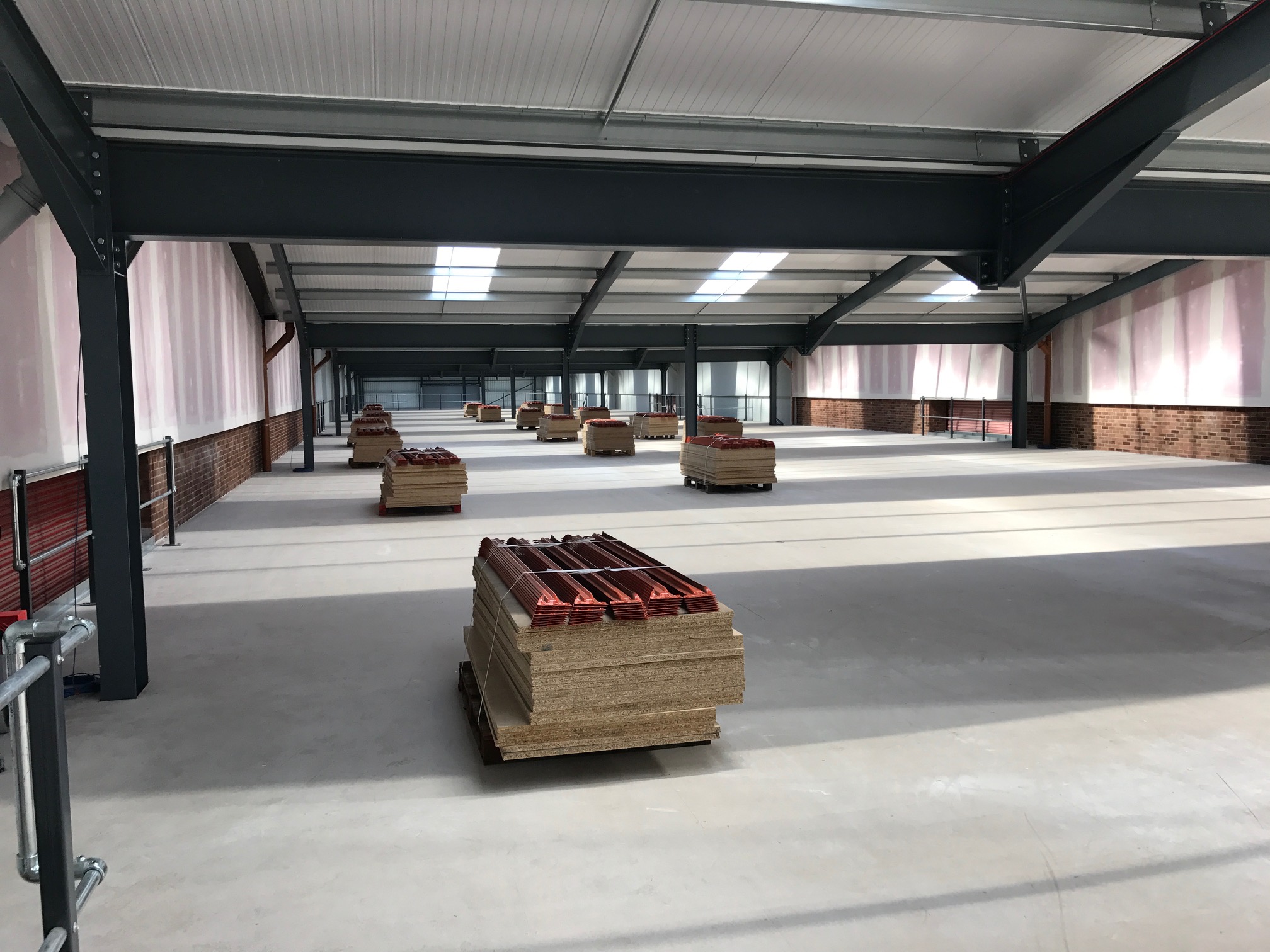
- Storage: Easily the most popular use. A storage mezzanine holds pallets, shelving, cartons, slow-moving or seasonal stock, freeing up the ground floor for picking and dispatch.
- Warehousing and distribution: A warehouse mezzanine adds capacity inside the building you already run, which is far cheaper than taking on a second unit.
- Offices: An office mezzanine lifts admin, supervisors or meeting rooms above the operation, often overlooking the floor below, with proper partitions, lighting and services.
- Retail: A retail mezzanine increases selling space or adds back-of-store stockroom without the business moving to a larger shop.
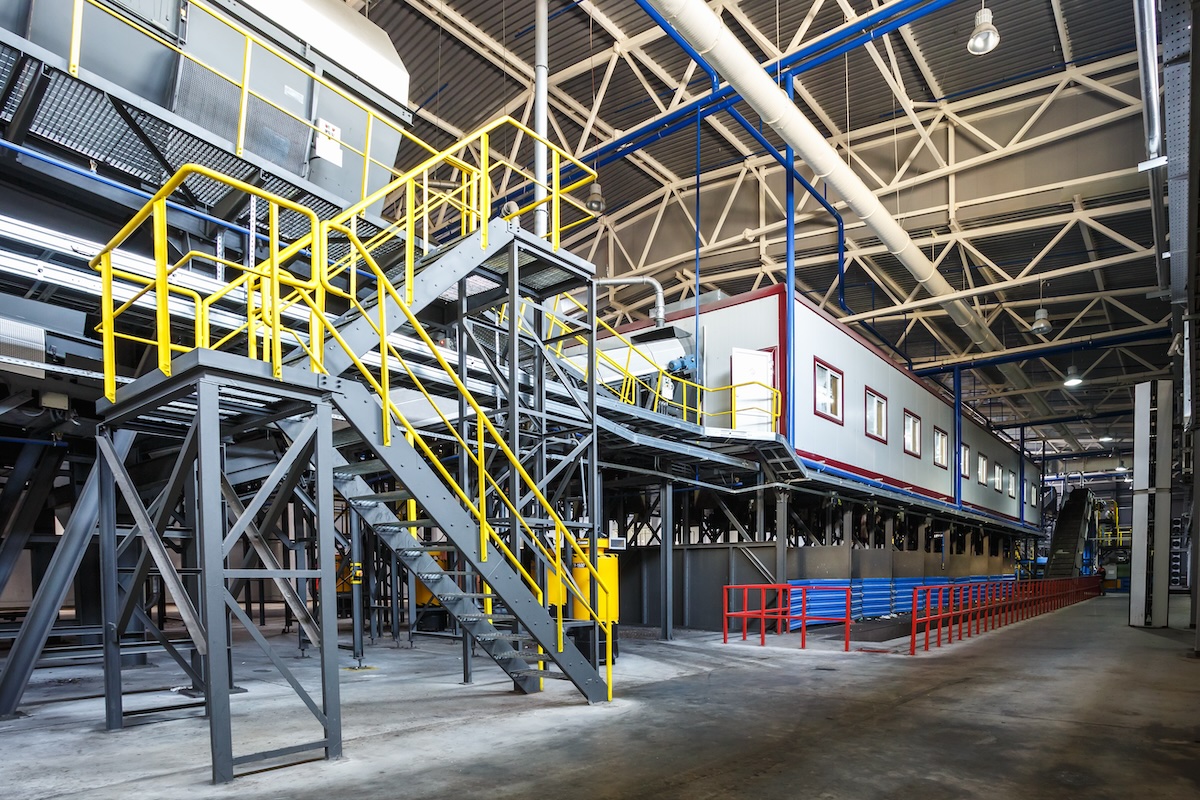
- Production and industrial use: Industrial mezzanines support assembly, packing, quality control or light manufacturing, with the floor specified to handle the equipment involved.
Because each floor is designed to order, a single mezzanine can combine uses too. It is common to put storage on one level and an office overlooking the floor on another.
Types of mezzanine floor
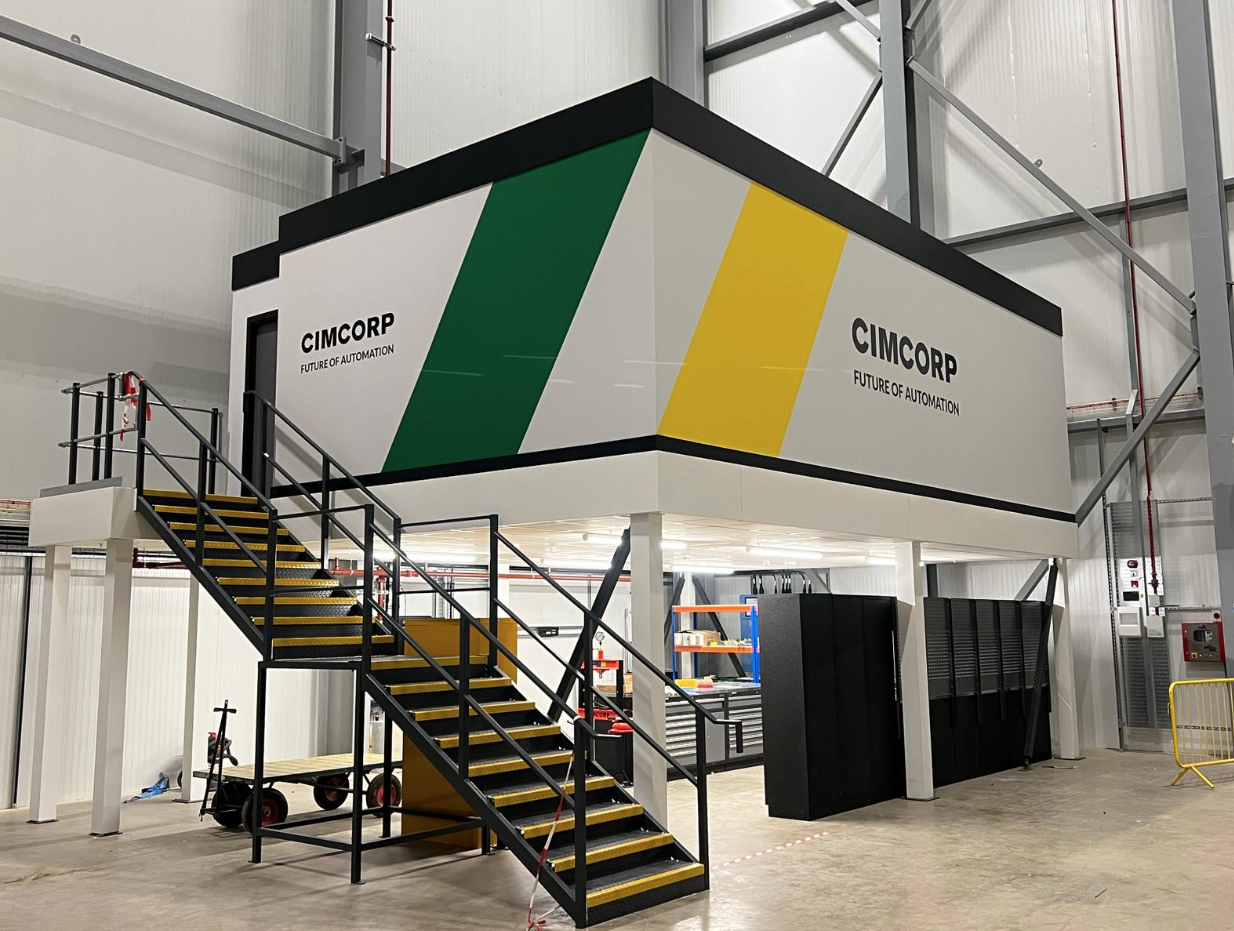
When people talk about types of mezzanine, they usually mean one of two things: how the structure is supported, or what it is used for.
By support method, the main options are:
- Freestanding or structural mezzanines. The most common type, supported by their own steel columns. They leave the space below clear and flexible, which is why they suit most warehouses and units.
- Rack-supported mezzanines. Here the storage racking itself carries the floor above, rather than separate columns. This packs in high-density storage and can be efficient where the whole structure is dedicated to storing goods.
- Shelf-supported mezzanines. A similar idea using shelving as the support, typically for smaller parts and hand-loaded stock.
You will also hear mezzanines described as single-tier or multi-tier. A two-tier or multi-tier mezzanine stacks more than one extra level into a tall building, multiplying the floor space you gain from the same footprint.
The benefits of a mezzanine floor (and the honest limitations)
The appeal of a mezzanine is easy to see, but it is worth being straight about where it is and is not the right answer.
The main benefits are:
- It is far cheaper than moving or extending: You are using space you already own rather than paying for new square footage and higher rent.
- It is quick and low-disruption: A mezzanine can usually be installed without shutting down your operation, unlike a relocation or a building extension.
- It is flexible: Many mezzanines can be adapted, extended or dismantled and reused if your needs change, which is useful in a leased building.
- It makes use of dead space: The height above your operation is space you are already heating and paying rent on, so putting it to work improves the value you get from the building.
The limitations are worth knowing too. A mezzanine needs enough height to work, so a building with low eaves may not suit one. It needs a ground floor slab strong enough to carry the load. And if your real problem is location, transport links or a building that is simply too small in every dimension, then a move may genuinely be the better call. A good installer will tell you honestly if a mezzanine is not the right fit.
How much does a mezzanine floor cost?
As a working figure, a freestanding industrial or storage mezzanine floor in the UK typically costs between £300 to £600 per square metre installed. That usually includes the steelwork, decking, staircases, handrails and the Building Regulations compliance that goes with it.
To put that in perspective, adding a few hundred square metres of mezzanine is usually a fraction of the cost of relocating to a larger unit, and it is a one-off capital cost rather than a permanent increase in rent and business rates.
Where you land in that range depends on a handful of factors:
- Size and number of levels: Larger floors and multi-tier structures cost more, though the price per square metre often improves with scale.
- Intended use and load capacity: A heavy-duty industrial floor needs more steel than a light office mezzanine, which affects the price.
- Access requirements: The number of staircases, and whether you need goods lifts or pallet gates, all add to the specification.
- The condition of the existing slab: If the floor needs strengthening to carry the load, that is an additional cost.
- Fire protection: Larger mezzanines may need fire-rated protection, which we cover in the regulations section below.
Because so much depends on the specification, the only way to get an accurate figure is a site survey. For a full breakdown of how a mezzanine stacks up against the alternative, our guide to warehouse relocation costs runs the numbers side by side.
Do you need planning permission and building regulations?
This is the part that puts people off, and it is more manageable than most expect.
In most cases, installing a mezzanine inside an existing building does not require planning permission. It usually falls under permitted development, as long as the outside of the building is unchanged. There are exceptions worth knowing about. If the mezzanine adds more than 200 square metres of floor space, planning permission can be required, and this comes up most often with retail premises. If you are unsure, it is worth checking with your local authority or asking your installer to confirm.
Building Regulations approval is a different matter and is always required for a commercial mezzanine, whether the building is new or existing. The main areas it covers are:
- Approved Document A (structure): Confirms the mezzanine is structurally sound and that the design and the existing slab can carry the loads safely.
- Approved Document B (fire safety): Covers means of escape, fire resistance and detection. Larger or occupied mezzanines may need fire-rated protection, fire-rated boarding to the underside, or upgraded alarms.
- Approved Document M (access): Deals with access to the floor, which is more relevant for offices and public spaces than for staff-only storage.
A reputable installer handles this process for you, including the structural calculations and the Building Regulations submission. We go into the full detail in our complete guide to mezzanine floor regulations in the UK.
How much space and height do you need?
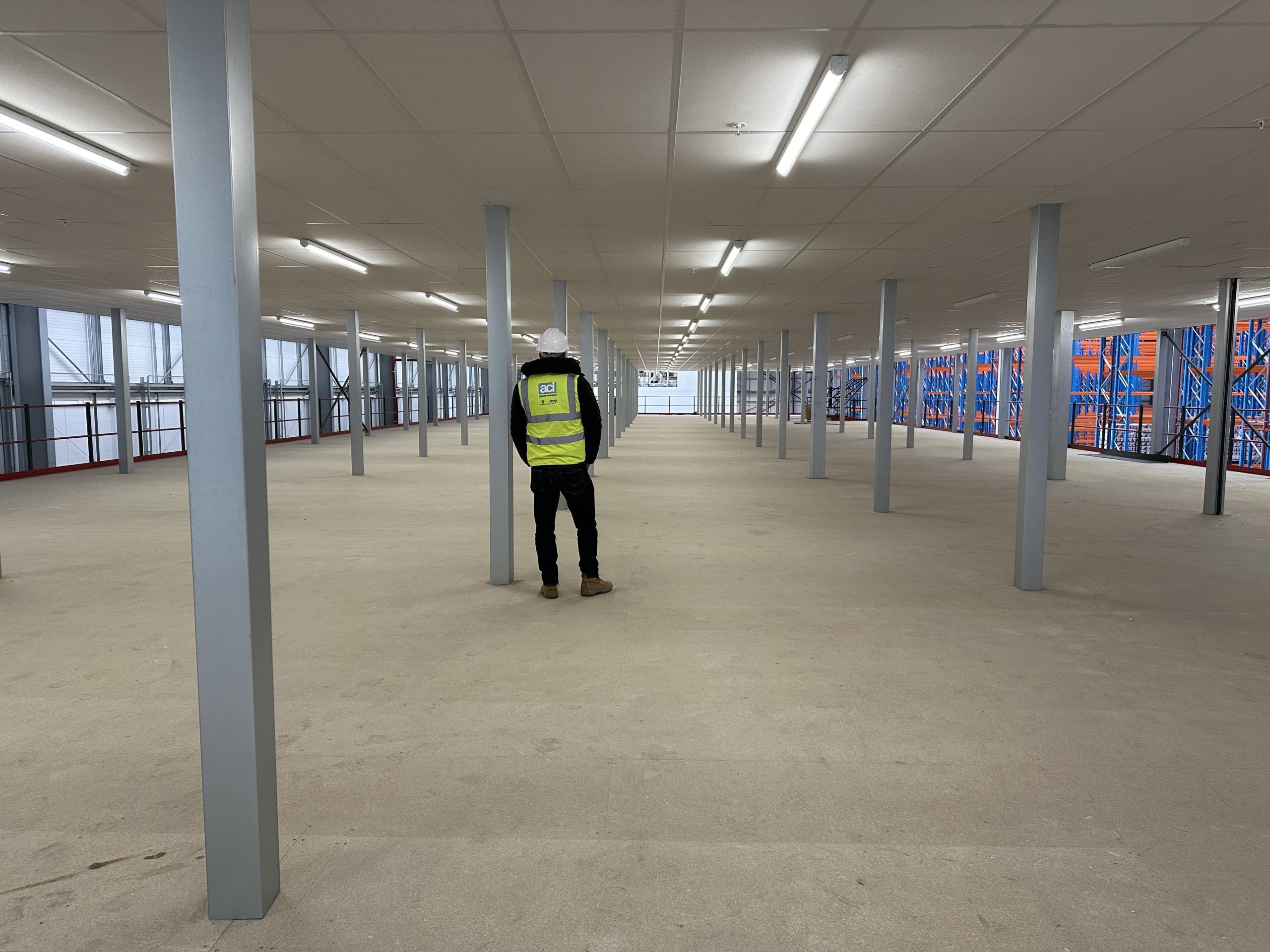
Two things decide whether a building can take a mezzanine: height and floor strength.
On height, the general rule is that you want around 2.4 metres of clear headroom below the deck for comfortable working, and a similar amount above it. In practice that means a building with a clear internal height of roughly 5 metres or more is well suited to a mezzanine. The legal minimum headroom for an occupied space is lower, at around 2 metres, but designing to the minimum rarely makes for a pleasant place to work. Buildings with lower eaves can sometimes still take a mezzanine, but the options become more limited.
On strength, the ground floor slab has to carry the weight of the columns and everything above them. Older units sometimes have thinner or weaker slabs than modern specifications, so this is checked before any design work is finalised.
The floor itself is then designed to a specific load capacity based on how you will use it. As a rough guide to the figures used across the UK industry:
- Office mezzanine: Around 300 to 350 kg per square metre
- Retail mezzanine: Around 400 kg per square metre
- Light storage: Around 480 kg per square metre
- Medium storage: Around 500 to 720 kg per square metre
- Heavy storage and industrial: Around 720 to 1,000 kg per square metre and above
Getting this right at the design stage matters, because upgrading a floor’s rating later is disruptive and expensive. There is more on this in our guide to mezzanine floor load capacity.
Mezzanine vs balcony, loft and gallery
Because the words get used loosely, it is worth clearing up how a mezzanine differs from a few things people often confuse it with.
- Mezzanine vs balcony: A balcony projects out from a wall and usually overlooks a space, often outdoors. A mezzanine is a full intermediate floor sitting within the building, supported by its own structure.
- Mezzanine vs loft: A loft is the space directly under the roof of a building. A mezzanine is an inserted level lower down, between the ground floor and the roof, and is engineered for a specific load and use.
- Mezzanine vs gallery: Gallery is often just another word for a small mezzanine that overlooks the floor below, particularly in retail or leisure settings. The structural principle is the same.
Can you claim tax relief on a mezzanine floor?
This is a common question, and the answer needs care, because the rules are stricter than a lot of suppliers suggest.
As a general rule, floors are specifically excluded from plant and machinery capital allowances under UK tax law. HMRC’s own guidance is explicit that this exclusion applies to raised and mezzanine floors in the same way as any other floor, so the starting assumption is that a mezzanine does not qualify for allowances.
There is an important exception. Where a mezzanine platform genuinely functions as storage equipment rather than as a floor, and is used solely for storage with access limited to staff, it has been accepted as qualifying plant. This comes from case law where movable mezzanine platforms used purely for warehouse storage were treated as storage equipment rather than part of the premises. HMRC’s position is that a mezzanine is either a floor or a large shelf, and rarely both, so a claim tends to either succeed in full or fail in full.
In plain terms, a storage-only mezzanine with staff access may qualify, while an office, retail or public-facing mezzanine generally will not. If it does qualify as plant, the expenditure can then potentially be relieved through the Annual Investment Allowance.
This is genuinely a grey area, and HMRC will usually want evidence such as drawings and photographs to support a claim. We are not tax advisers, so before you factor any tax relief into your decision, speak to your accountant and have them review the specifics of your installation. You can read HMRC’s guidance on the treatment of floors in their Capital Allowances Manual (CA22070).
How a mezzanine floor gets installed
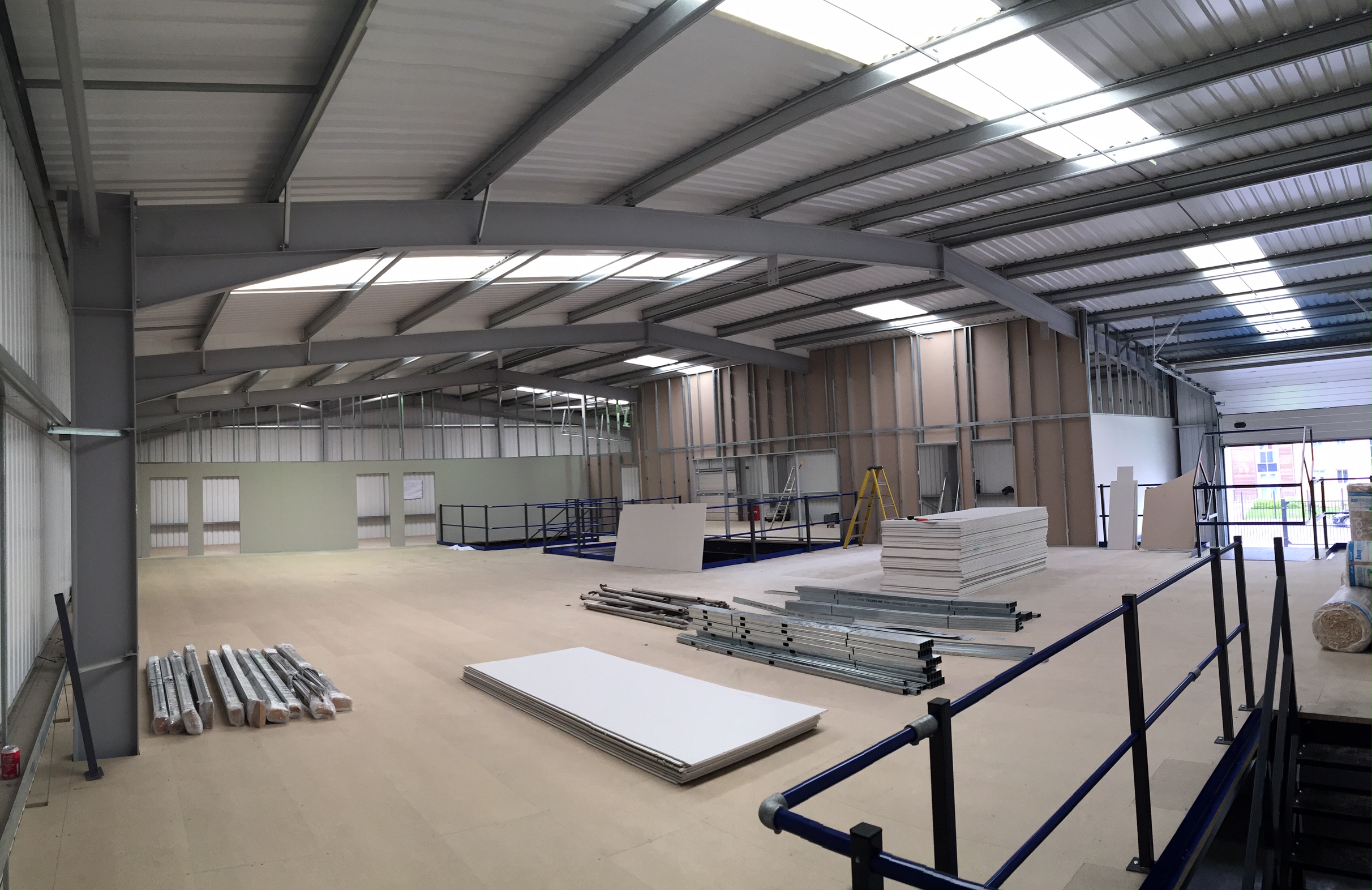
Most mezzanine projects follow the same broad path, so you know what to expect:
- Site survey: The installer assesses your building, the available height, the floor slab and how you want to use the space.
- Design: Detailed structural drawings are produced, with the layout, column positions, access and load capacity worked out around your operation.
- Approval: The structural calculations and design are submitted for Building Regulations approval.
- Manufacture: The steelwork and components are fabricated to the approved design.
- Installation: The structure is built on site, usually with minimal disruption to your day-to-day operation.
- Sign-off: On completion the floor is certified as compliant, and its load capacity rating is displayed on the structure itself, which is a regulatory requirement.
The earlier you involve a specialist, the more design options stay open, so it pays to start the conversation before you have locked yourself into a particular layout.
Talk to The Mezzanine Company
If you have run out of space, a mezzanine floor is very often the cheapest and least disruptive way to get more of it, without the cost and upheaval of moving. The best place to start is to find out how much usable space your building could actually gain.
We design and build mezzanine floors for businesses across the East Midlands and the wider UK. Our team will carry out a free site survey, talk through how you want to use the space, and give you a clear, no-obligation quote before you commit to anything.
Frequently asked questions
What is a mezzanine floor in simple terms?
A mezzanine floor is a raised platform built inside an existing building, between the ground floor and the roof, that adds an extra level of usable space. It uses the empty height in a building so you can expand upwards without moving or extending.
What is a mezzanine floor used for?
The most common use is storage, but mezzanines are also used for offices, retail space, warehousing, production and packing. Because each floor is designed for its purpose, a single mezzanine can combine uses, such as storage on one level and an office overlooking the floor below.
How much does a mezzanine floor cost in the UK?
A freestanding industrial or storage mezzanine typically costs between £300 and £600 per square metre installed, including steelwork, decking, staircases, handrails and Building Regulations compliance. The final figure depends on size, intended use, access requirements and the condition of the existing floor slab.
Do I need planning permission for a mezzanine floor?
Usually not. Installing a mezzanine inside an existing building normally falls under permitted development, provided the outside of the building is unchanged. Planning permission can be required if the mezzanine adds more than 200 square metres of floor space, which most often applies to retail premises. Building Regulations approval is always required.
How much height do I need for a mezzanine floor?
As a rule of thumb you want around 2.4 metres of clear height below the deck and a similar amount above it, which means a building with roughly 5 metres or more of clear internal height is well suited to a mezzanine. Lower buildings can sometimes still work, but with more limited options.
Can a mezzanine floor be removed or relocated?
In most cases, yes. Freestanding mezzanines are built from bolted steel and are designed so they can be altered, extended or dismantled and reused, which makes them a flexible option for leased buildings.
Can you claim capital allowances on a mezzanine floor?
Sometimes, but not automatically. Floors are generally excluded from plant and machinery allowances. A mezzanine used solely for storage with staff-only access may qualify as storage equipment, while office, retail and public-facing mezzanines generally will not. Always check the specifics with your accountant.