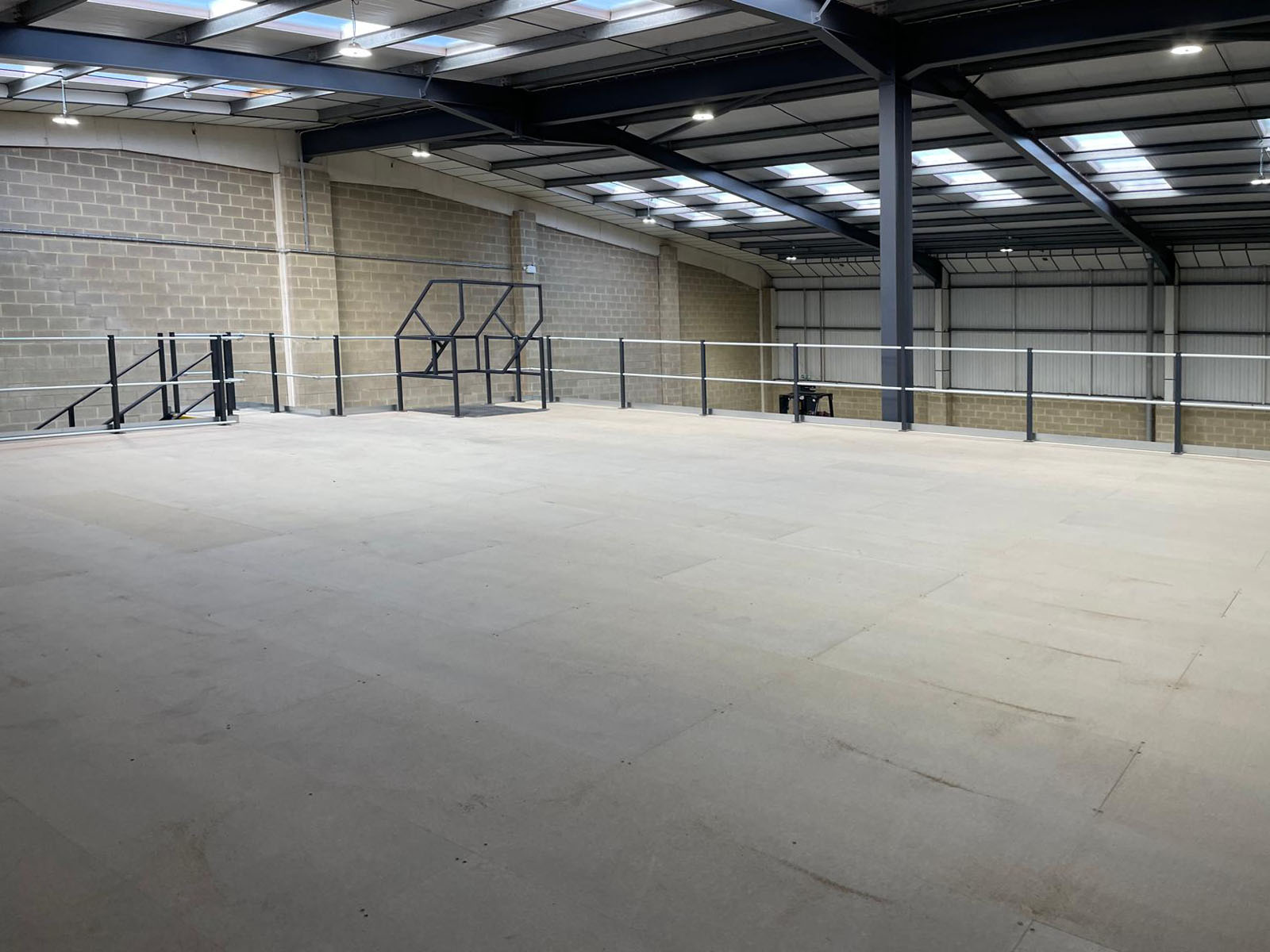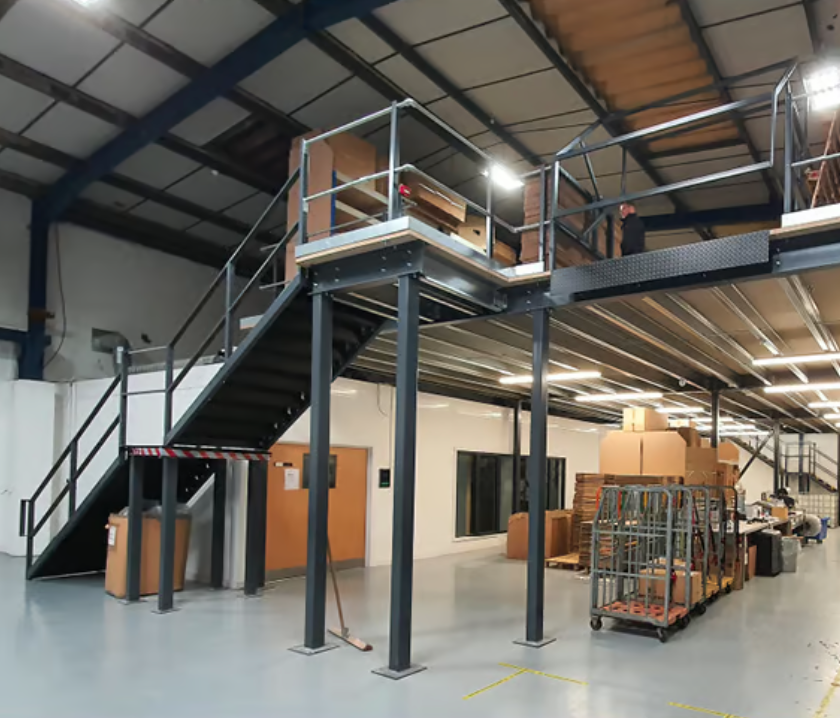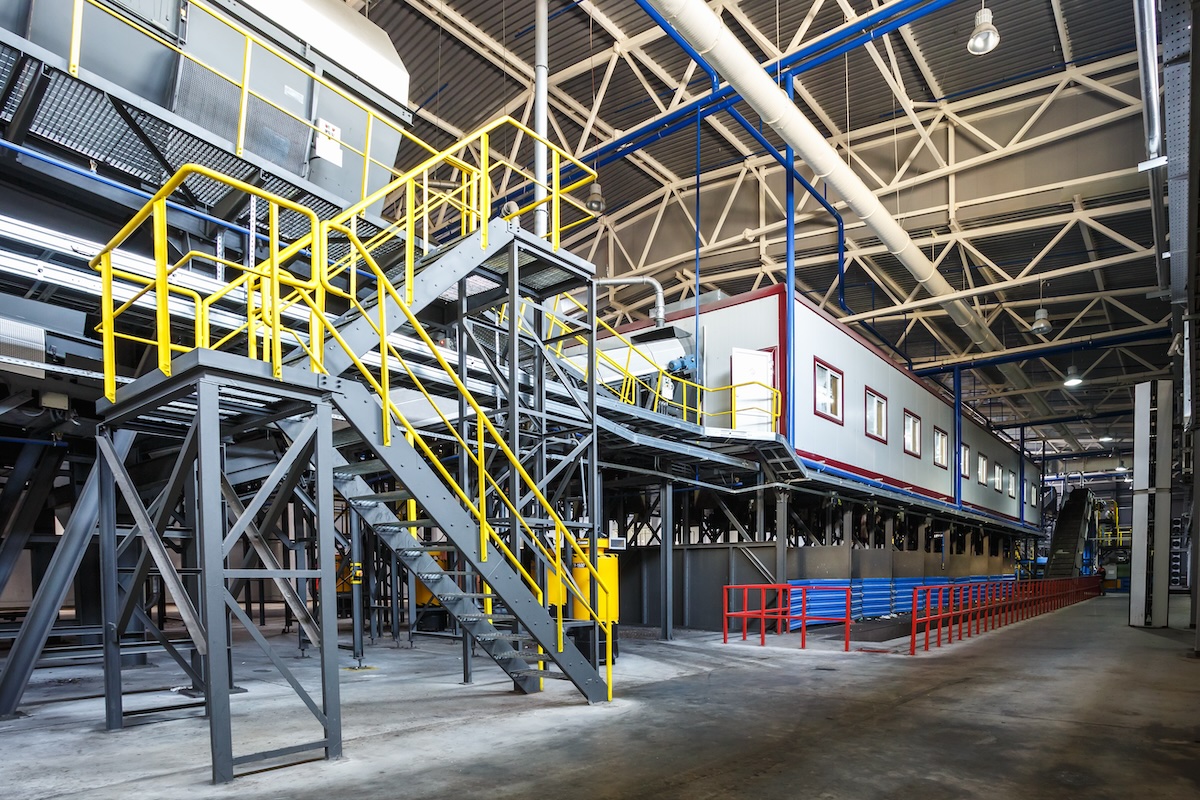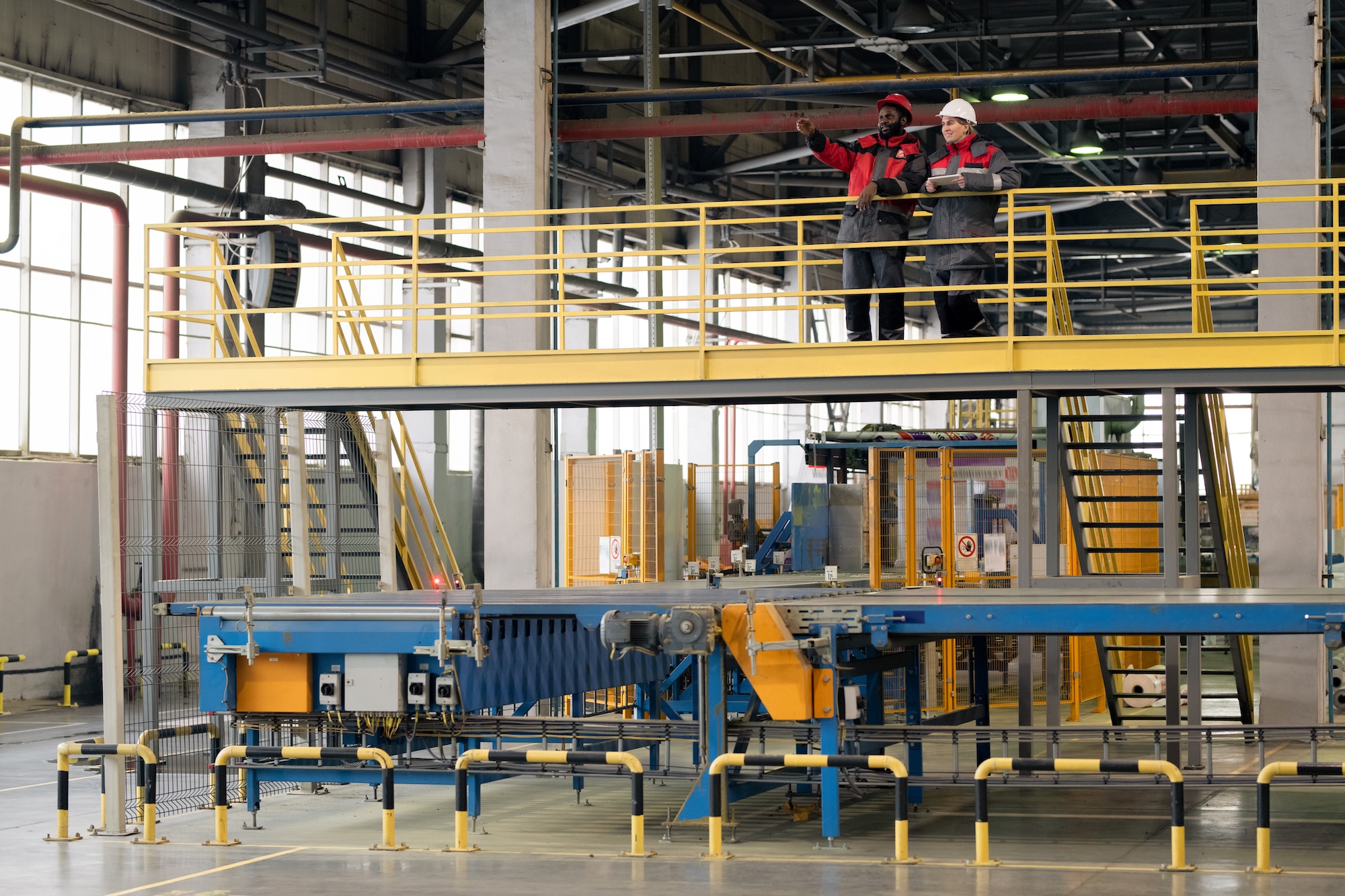
Mezzanine floor regulations apply to all mezzanines installed in the UK. They broadly cover aspects such as planning permission, building control to fire safety, structural requirements and accessibility.
Whether the aim is to create additional storage, a new office level, an extra retail floor, or more production space, a well-designed mezzanine can transform a single-storey commercial building into a two-level workspace.
However, installing a mezzanine floor is not simply a matter of construction. Failure to comply with any of the requirements can result in enforcement notices, fines and complications when selling or re-letting the property.
In this guide from The Mezzanine Company, we’ll run through all of the requirements that apply when installing a mezzanine floor in the UK.
For tailored advice applicable to your business, please call us on 0115 939 7572.
Why Are Mezzanine Floor Regulations Important?
| Quick facts | Detail |
|---|---|
| Building regs approval | Required for virtually all commercial and domestic mezzanines |
| Fire protection trigger | Mezzanines over 20 m long or covering more than 50% of the floor area |
| Max travel distance to exit | 18 metres (Approved Document B) |
| Min. handrail height (commercial) | 1,100 mm |
| Min. handrail height (domestic) | 900 mm |
| CDM 2015 | Applies to most commercial mezzanine projects |
| Planning permission | Not usually required — key exceptions apply (see below) |
Mezzanine floors must meet specific legal and safety standards because they introduce a new structural element into an existing building, alter how that building is used, and create new risks, particularly around fire escape and structural integrity.
The primary legislation is The Building Regulations 2010 (SI 2010/2214), which sets legally enforceable standards for the design and construction of all building work in England and Wales. Where the mezzanine is used as a workplace, the Regulatory Reform (Fire Safety) Order 2005 also applies, placing ongoing fire safety duties on the employer or building owner.
Non-compliance can have serious consequences. Local authority building control officers have powers to serve enforcement notices requiring non-compliant structures to be altered or removed. A mezzanine floor installed without building control sign-off can also create significant complications when the time comes to sell or re-let the property, as a future buyer’s solicitor will expect to see the completion certificate.
Planning Permission For Mezzanine Floors
In the majority of cases, a mezzanine floor installation does not require planning permission. Because a mezzanine is an internal alteration that does not change the external appearance of the building, it generally falls within Permitted Development rights under the Town and Country Planning Act 1990.
Planning Permission Is Typically Required When:
- The mezzanine will be used for retail purposes and the new floor area exceeds 200 m², triggering a change under Class E of the Town and Country Planning (Use Classes) Order 1987 (as amended 2020).
- The building is listed, or is located within a conservation area.
- External alterations to the building are needed to accommodate the mezzanine – for example, new windows, ventilation openings or loading doors.
- The installation constitutes a material change of use, such as converting part of a storage warehouse into offices where the building does not already hold the relevant planning use class.
- The site has specific planning conditions that restrict permitted development rights.
Planning Permission Is Not Typically Required For:
- A storage or production mezzanine within an industrial, warehouse, or factory building.
- An office mezzanine within a building that already holds Class E (commercial, business and service) planning consent.
- A retail mezzanine of 200 m² or under within a building that already has retail planning consent.
- Any internal mezzanine where no external alterations are required and there is no change of use.
If there is any doubt about whether planning permission is required, the safest course of action is to submit a lawful development certificate application to the local planning authority before work begins. Further guidance is available at www.planningportal.co.uk.
Note: Scotland, Wales and Northern Ireland each have separate building regulations frameworks. Scotland uses the Building (Scotland) Regulations 2004; Wales has its own Approved Documents; Northern Ireland uses the Building Regulations (Northern Ireland) 2012. Readers outside England and Wales should consult their local authority building standards department.
Building Regulations Approval For Mezzanine Floors
| Document / Standard | What it covers |
|---|---|
| Approved Document A | Structure — structural stability and integrity |
| Approved Document B | Fire Safety — fire resistance, escape routes, smoke detection (Volume 2 for non-dwellings; Volume 1 for dwellinghouses) |
| Approved Document K | Protection from Falling — handrails, balustrades, staircase specifications |
| Approved Document M | Access and Use — disabled access requirements |
| BS 5950-1:2000 | Structural use of steelwork in buildings — the design standard your structural engineer works to |
| BS 6399-1:1996 | Loading for buildings — dead, imposed, and wind loads |
| BS EN 1991-1-1 | Eurocode 1: Actions on structures — used for balustrade loading calculations |
Building regulations approval is a legal requirement before any mezzanine floor installation begins. The Building Regulations 2010 set enforceable standards covering the design and construction of all building work in England and Wales. Approval must be obtained from either a Local Authority Building Control (LABC) officer or a Registered Building Control Approver (RBCA) before construction starts – not retrospectively.
The aspects covered by building regulations for mezzanine floors include structural integrity, fire safety, protection from falling, access for disabled people, ventilation, lighting and emergency evacuation routes.
Two Routes To Building Regulations Approval
Full Plans (recommended for commercial mezzanines)
- Submit detailed structural drawings and calculations to LABC or an RBCA before work begins.
- Approval is typically granted within five weeks, or up to two months if agreed.
- Provides written approval before construction starts — strongly recommended for all commercial installations.
Building Notice
- Notify building control 48 hours before work begins – no detailed drawings required upfront.
- An inspector visits during construction to check compliance at key stages.
- Not suitable for mezzanines subject to the Regulatory Reform (Fire Safety) Order 2005 or the CDM Regulations 2015. Use the Full Plans route for these projects.
What The Building Control Inspector Checks
- Structural calculations signed off by a qualified structural engineer.
- Core sample results from the existing concrete slab at proposed column positions.
- Compliance with Approved Document B – fire-rated elements and escape routes.
- Staircase dimensions, balustrade heights, and handrail specification.
- Disabled access provisions where required under Approved Document M.
- Electrical installation, where new lighting, sockets, or emergency lighting is included.
Fire Safety Regulations For Mezzanine Floors
Fire safety is one of the most critical aspects of mezzanine floor compliance. The requirements are set out in Approved Document B (Fire Safety) of the Building Regulations 2010, together with the Regulatory Reform (Fire Safety) Order 2005, which governs ongoing fire safety management in non-domestic buildings.
When Fire Protection Measures Are Required
Fire protection is required for a mezzanine floor when any of the following conditions are met:
- The mezzanine covers more than 50% of the area of the space in which it is installed, OR
- The mezzanine exceeds 20 metres in length in any direction, OR
- The mezzanine is regularly occupied by three or more people (i.e., it is used as a workspace rather than for occasional access storage), OR
- The mezzanine is used to store flammable goods or materials that carry a higher fire risk.
What fire protection involves
1-hour structural fire rating
Structural elements (i.e. columns, main beams and floor decking) must resist fire for a minimum of 60 minutes without fully igniting. This is achieved through:
- Column casing – intumescent paint or fire-rated board encasement applied to all steelwork columns.
- Fire-protected suspended ceiling – installed on the underside of the mezzanine floor deck, providing the rated separation between the space below and the floor above.
- Fire-resistant fascia panels – applied to the perimeter of the mezzanine structure.
Fire escape routes
- No point on the mezzanine floor may be more than 18 metres from the nearest fire exit. This is the maximum travel distance for areas of normal fire risk in a single-direction escape scenario (Approved Document B).
- Where a mezzanine exceeds 20 metres in length, more than one staircase exit is typically required to comply with the 18-metre travel distance rule.
- Staircase exits that form part of a protected escape route must themselves be constructed to the required fire rating.
Smoke detection
- BS 5839-1 compliant smoke detectors must be installed beneath the mezzanine (in the void created by the fire-rated ceiling) and on the mezzanine level wherever it is regularly occupied.
Fire-resistant partitions
- Where the underside of the mezzanine is enclosed to create an office, storage room, or other space, fire-resisting construction is required for the enclosing walls and any door sets.
The Sprinkler System Exemption
Where an existing sprinkler system that complies with BS EN 12845 is already installed in the building and that system extends below the mezzanine level, building control may agree to waive the requirement for structural fire rating of the mezzanine. If this applies to your project, confirm with building control at the earliest opportunity – it can significantly reduce the cost and complexity of fire protection.
Structural Safety And Load Capacity
Ensuring that a mezzanine floor is structurally sound is a fundamental requirement of the building regulations process. The floor must be capable of supporting the intended loads safely, and this must be demonstrated through formal structural calculations before building control approval is granted.
Design Standards
- All mezzanine floor steelwork must be designed in accordance with BS 5950-1:2000 (structural use of steelwork in buildings) and BS 6399-1:1996 (loading for buildings – dead, imposed, and wind loads).
- A structural engineer will produce a full set of calculations demonstrating compliance. These form part of the building control submission, along with the structural drawings.
- The engineer’s scope includes assessing foundations, column grids, primary and secondary beams and the floor deck specification.
Load Capacity By Intended Use
| Intended use | Typical imposed load | Notes |
|---|---|---|
| Office / light storage | 350 kg/m² (3.5 kN/m²) | Standard for desks, chairs, filing, and light equipment |
| Retail / medium storage | 480 kg/m² (4.8 kN/m²) | Display units, shelving, and regular customer footfall |
| Heavy storage / warehouse racking | 720 kg/m² (7.2 kN/m²) | Loaded pallet racking systems and heavier goods |
| Heavy plant / industrial machinery | 960 kg/m²+ (9.6+ kN/m²) | Confirm exact requirements with your structural engineer |
The imposed load a mezzanine must be designed to carry depends on its intended use. The following are standard design loads used in UK practice:
These figures are guides. The structural engineer will confirm the exact specification based on actual loads, column grid, span lengths and building geometry.
Slab Core Samples
- Building control will typically require core samples to be taken from the existing concrete slab at proposed column positions, to verify that the slab has sufficient load-bearing capacity.
- If the slab is found to be inadequate, remedial measures such as ground beams or spread plates beneath the column bases will be required. This adds cost and programme time, so early investigation is advisable.
CDM Regulations 2015
| Duty holder | Role and responsibilities |
|---|---|
| Client | The business commissioning the mezzanine. Must ensure suitable arrangements are in place for managing the project, including appointing a Principal Designer and Principal Contractor where required. |
| Principal Designer | Appointed in writing where more than one contractor is involved. Plans, manages, monitors, and coordinates health and safety during the pre-construction phase. On most mezzanine projects, this role is held by the mezzanine specialist. |
| Principal Contractor | Appointed in writing where more than one contractor is involved. Plans, manages, and coordinates construction phase health and safety. Produces and maintains the Construction Phase Plan. |
| Designer | Anyone who prepares or modifies designs (including structural engineers and architects) must consider and eliminate or reduce foreseeable risks in their designs. |
| Contractor | Any firm carrying out the physical installation work. Must comply with the Construction Phase Plan and cooperate with the Principal Contractor. |
The Construction (Design and Management) Regulations 2015 (CDM 2015) place legal health and safety duties on clients, designers, and contractors across all construction projects in Great Britain. Most commercial mezzanine installations fall within the scope of CDM 2015, and all parties – including the business commissioning the mezzanine have specific duties.
When Must A Project Be Notified To The HSE?
A mezzanine installation must be formally notified to the HSE (using the online F10 form) if it meets either of the following thresholds:
- The construction phase will last longer than 30 working days with more than 20 workers simultaneously on site, OR
- The project will exceed 500 person-days in total.
Most standard mezzanine installations do not reach these thresholds. Where notification is required, it must be submitted before the construction phase begins.
Construction Phase Plan And Health And Safety File
- All CDM projects require a Construction Phase Plan to be prepared by the Principal Contractor before work begins, setting out how health and safety will be managed during installation.
- On completion, the Principal Designer must prepare a Health and Safety File and hand it to the client. This contains as-built drawings, structural calculations, material specifications, and maintenance information – essential for any future modifications or inspections.
- The Health and Safety File must be kept and passed on to any future owner or occupier of the building.
Handrails, Balustrades And Edge Protection
| Location | Minimum height | Regulation |
|---|---|---|
| Commercial mezzanine — all open edges | 1,100 mm | Approved Document K |
| Domestic mezzanine — all open edges | 900 mm | Approved Document K (dwellings) |
| Staircase handrail — commercial | 900–1,000 mm above pitch line | Approved Document K |
| Staircase handrail — domestic | 900 mm above pitch line | Approved Document K |
All open edges of a mezzanine floor must be protected by a balustrade system to prevent falls. The requirements are set out in Approved Document K (Protection from Falling, Collision and Impact) and the Workplace (Health, Safety and Welfare) Regulations 1992.
Structural Loading
- Commercial mezzanine balustrades must be designed to resist a horizontal load of 0.74 kN per linear metre (approximately 74 kg per metre of run), in accordance with BS EN 1991-1-1 (Eurocode 1) and Approved Document K.
- This loading requirement must be incorporated into the structural design of the balustrade posts and their connections to the mezzanine structure.
Toe Boards
- Where goods, tools, or materials could fall from the edge of the mezzanine, particularly in warehouse, factory or storage environments – toe boards of at least 150 mm in height must be fitted at all open edges (Workplace (Health, Safety and Welfare) Regulations 1992, Regulation 13).
Design Requirements
- The balustrade design must not incorporate horizontal rails or other elements that could be used as footholds, particularly in environments accessible to children such as retail mezzanines.
- Glass infill panels are permitted and commonly used in office and retail mezzanines — these must comply with the safety glazing requirements of Approved Document K (toughened or laminated glass to BS EN 12150 or BS EN 14449).
Staircase Regulations For Mezzanine Floors
| Specification | Requirement (commercial) |
|---|---|
| Minimum clear width | 1,000 mm (regular employee or public access); 600 mm (maintenance access only) |
| Maximum riser height | 220 mm |
| Minimum going (tread depth) | 220 mm |
| Minimum headroom clearance | 2,000 mm measured vertically above the pitch line |
| Handrail height | 900–1,000 mm above the pitch line of the stair |
| Handrail on both sides | Required where stair width exceeds 1,000 mm |
| Maximum risers between landings | 16 (Approved Document K) |
| Maximum pitch | 42° for general access stairs |
The staircase providing access to a mezzanine floor must comply with Approved Document K. Key specifications for commercial mezzanine staircases are as follows.
For full detail on staircase specifications including open-riser rules, stair types, and spiral staircases, see: Mezzanine Staircase Building Regulations and UK Standards.
Accessibility And Disabled Access
Where a mezzanine floor is to be used by employees or members of the public, the Equality Act 2010 requires that reasonable adjustments be made to ensure it is accessible to all users, including those with disabilities. The building regulations requirements are set out in Approved Document M (Access and Use).
What constitutes a ‘reasonable’ adjustment is context-dependent and takes into account the size of the business, the cost of the provision, the practicality of installation, and the nature of the use. For commercial mezzanines used as offices, retail areas, or any space accessible to the public, a lift or ramp solution will generally be expected unless there is a specific structural or spatial reason why it cannot be provided.
For purely storage mezzanines with no regular employee access (used only for placing and retrieving goods) disabled access provisions may not be required, but this should be confirmed with your building control officer on a project-by-project basis.
Practical Solutions
- A platform lift (also referred to as a goods and passenger lift) is the most common solution. It enables wheelchair users and those with limited mobility to access the upper level independently.
- Platform lift installations require their own separate building regulations application and must comply with BS EN 81-41 (safety rules for vertical platform lifts).
- In addition to lifts, wider staircases, handrails on both sides, adequate landing space, and clear signage all contribute to accessible design.
- In retail environments accessible to the public, the mezzanine should provide equivalent access to the same goods and services as the ground floor, so far as reasonably practicable.
Health And Safety Requirements
Mezzanine floors used as workplaces are subject to the Health and Safety at Work etc. Act 1974, which places a general duty on employers to ensure the health, safety and welfare of employees. Two sets of more specific regulations also apply.
Workplace (Health, Safety and Welfare) Regulations 1992
These regulations set minimum standards for any occupied workplace, including mezzanine floors used as offices, production areas, or other workspaces. Key requirements include:
- Ceiling height: A minimum height of 3 metres is required in areas where people work. For office use with fixed workstations, 2.5 metres may be acceptable in practice and the building control officers apply judgement here. Both the space above the floor deck and the space below must achieve a workable height.
- Space per person: A minimum of 11 cubic metres of space per person is required in any workplace (total room volume, not floor area alone).
- Ventilation (Regulation 6): Every enclosed workplace must have effective and suitable ventilation. For a mezzanine office, this typically requires either a connection to the building’s HVAC system or a new ventilation opening — a cost and planning consideration to factor in at design stage.
- Lighting (Regulation 8): Suitable and sufficient lighting must be provided, including emergency lighting in accordance with BS 5266-1.
Source: Workplace (Health, Safety and Welfare) Regulations 1992. HSE guidance — Workplace health, safety and welfare (INDG244).
Work at Height Regulations 2005
- The Work at Height Regulations 2005 apply during the installation and any subsequent maintenance of the mezzanine floor.
- The Principal Contractor must ensure that all work at height during construction is properly planned, supervised, and carried out by competent workers – this feeds directly into the CDM 2015 Construction Phase Plan.
- Ongoing maintenance activities, such as replacing overhead lighting or inspecting the mezzanine structure must also be planned in accordance with these regulations. The Health and Safety File produced at project completion should include guidance on safe maintenance access.
Source: Work at Height Regulations 2005.
Landlord Consent and Lease Obligations
For businesses operating from leased premises, obtaining landlord consent is a separate and additional legal requirement to building regulations approval. Both must be in place before work begins.
Most commercial leases contain an alterations clause requiring the tenant to obtain the landlord’s written consent before carrying out any structural alterations. Installing a mezzanine floor is almost always classified as a structural alteration, regardless of whether it is freestanding or fixed to the building fabric.
The Landlord Consent Process
- Submit a formal application to the landlord or their managing agent, including structural drawings and the building control approval notice (or full plans approval in principle).
- The landlord will typically require their own surveyor or solicitor to review the proposals AND the costs of this review are usually borne by the tenant.
- Consent is formalised in a Licence for Alterations, which sets out the permitted works, any conditions attached, and the reinstatement obligations at lease end.
- Some leases contain restrictions on alterations that materially increase the lettable floor area. Review the lease with a commercial property solicitor before proceeding.
Important: Landlord consent can take several weeks to obtain. Begin the application at the same time as the building regulations submission, not after. Never start installation before both consents are confirmed in writing – commencing work without landlord consent is a breach of the lease and can result in forfeiture proceedings.
Dilapidations – Reinstatement At Lease End
Most commercial leases include a yield-up clause requiring the tenant to restore the property to its original condition when vacating. In practice, a mezzanine floor installed during the tenancy may need to be fully removed at the tenant’s cost.
- Negotiate the reinstatement obligation before signing the Licence for Alterations. It may be possible to agree that the mezzanine can remain, particularly where it adds value to the property.
- A Schedule of Condition prepared at the time of installation provides a baseline record of the building’s state, protecting both parties at lease end.
- If reinstatement is required, factor the cost, (i.e. structural dismantling, floor repairs, redecoration and building control sign-off for the removal works) into the original business case for the mezzanine.
This section provides general guidance only and does not constitute legal advice. Always obtain independent advice from a qualified commercial property solicitor before entering into any Licence for Alterations.
Conclusion
| ✓ | Requirement |
|---|---|
| ☐ | Building regulations approval obtained — Full Plans route recommended for all commercial installations |
| ☐ | Structural engineer appointed — calculations produced to BS 5950-1:2000 and BS 6399-1:1996 |
| ☐ | Slab core samples taken and confirmed adequate at all column positions |
| ☐ | Fire safety triggers assessed — 50% floor area, 20 m length, and 3+ regular occupants thresholds checked |
| ☐ | 1-hour fire rating specified where required (column casing, fire-rated ceiling, fire-resistant fascia panels) |
| ☐ | Maximum travel distance to fire exit confirmed as 18 metres or less from all points on the mezzanine |
| ☐ | Smoke detection installed in accordance with BS 5839-1 |
| ☐ | Balustrade height confirmed — 1,100 mm minimum (commercial) or 900 mm (domestic) |
| ☐ | Balustrade designed to 0.74 kN/m horizontal load per BS EN 1991-1-1 |
| ☐ | Toe boards of at least 150 mm fitted at all open edges (warehouse / factory / storage environments) |
| ☐ | Staircase complies with Approved Document K — min. 1,000 mm width, max. 220 mm riser, 2,000 mm headroom |
| ☐ | CDM 2015 — Principal Designer and Principal Contractor appointed in writing where required |
| ☐ | Construction Phase Plan prepared before work begins |
| ☐ | HSE notified via F10 if project exceeds 30 working days with 20+ simultaneous workers, or 500 person-days |
| ☐ | Disabled access provision assessed — platform lift included where required under Approved Document M |
| ☐ | Planning permission confirmed as not required — or obtained if required |
| ☐ | Landlord consent (Licence for Alterations) obtained in writing before work begins (leasehold premises only) |
| ☐ | Health and Safety File prepared and handed to client on completion |
Installing a mezzanine floor is an effective and often cost-efficient solution for businesses that need more space without the disruption and expense of relocating. However, it requires careful navigation of building regulations, fire safety law, structural standards, CDM duties, and in many cases planning permission and landlord consent.
To summarise the key obligations:
- Building regulations approval is legally required for virtually all commercial and domestic mezzanine floors.
- Fire protection measures are required where the mezzanine exceeds 20 metres in length, covers more than 50% of the ground floor area, or is regularly occupied by three or more people.
- CDM 2015 duties apply to most commercial projects and a Principal Designer and Principal Contractor must be appointed where more than one contractor is involved.
- Balustrades on commercial mezzanines must reach a minimum height of 1,100 mm and be designed to resist a horizontal load of 0.74 kN/m.
- Disabled access must be provided where the mezzanine is used by employees or the public and it is reasonably practicable to do so.
- Tenants must obtain landlord consent in addition to building regulations approval and must factor reinstatement costs into the decision.
Need Advice About Mezzanine Floor Regulations UK?
At The Mezzanine Company, we act as the designated designer and Principal Designer on every project we undertake, managing the full design, building control and CDM compliance process on our clients’ behalf. Our team has over 25 years of experience designing and installing compliant commercial mezzanine floors across the UK.
If you have a project in mind, get in touch for a free quote and site survey — we will guide you through the regulatory process from the first conversation.
| Source | URL |
|---|---|
| Building Regulations 2010 | legislation.gov.uk/uksi/2010/2214 |
| Approved Document A — Structure | gov.uk — Approved Document A |
| Approved Document B — Fire Safety | gov.uk — Approved Document B |
| Approved Document K — Protection from Falling | gov.uk — Approved Document K |
| Approved Document M — Access and Use | gov.uk — Approved Document M |
| CDM Regulations 2015 — HSE guidance | hse.gov.uk — CDM 2015 |
| Regulatory Reform (Fire Safety) Order 2005 | legislation.gov.uk/uksi/2005/1541 |
| Workplace (Health, Safety & Welfare) Regulations 1992 | legislation.gov.uk/uksi/1992/3004 |
| Work at Height Regulations 2005 | legislation.gov.uk/uksi/2005/735 |
| Equality Act 2010 | legislation.gov.uk/ukpga/2010/15 |
| Town and Country Planning Act 1990 | legislation.gov.uk/ukpga/1990/8 |
| Use Classes Order 1987 (as amended 2020) | legislation.gov.uk/uksi/1987/764 |
| Party Wall etc. Act 1996 | legislation.gov.uk/ukpga/1996/40 |
| GOV.UK — Building regulations approval | gov.uk/building-regulations-approval |
| Planning Portal | planningportal.co.uk |
| HSE — F10 notification form | hse.gov.uk — F10 form |
| HSE — Building Safety Regulator | hse.gov.uk/building-safety |