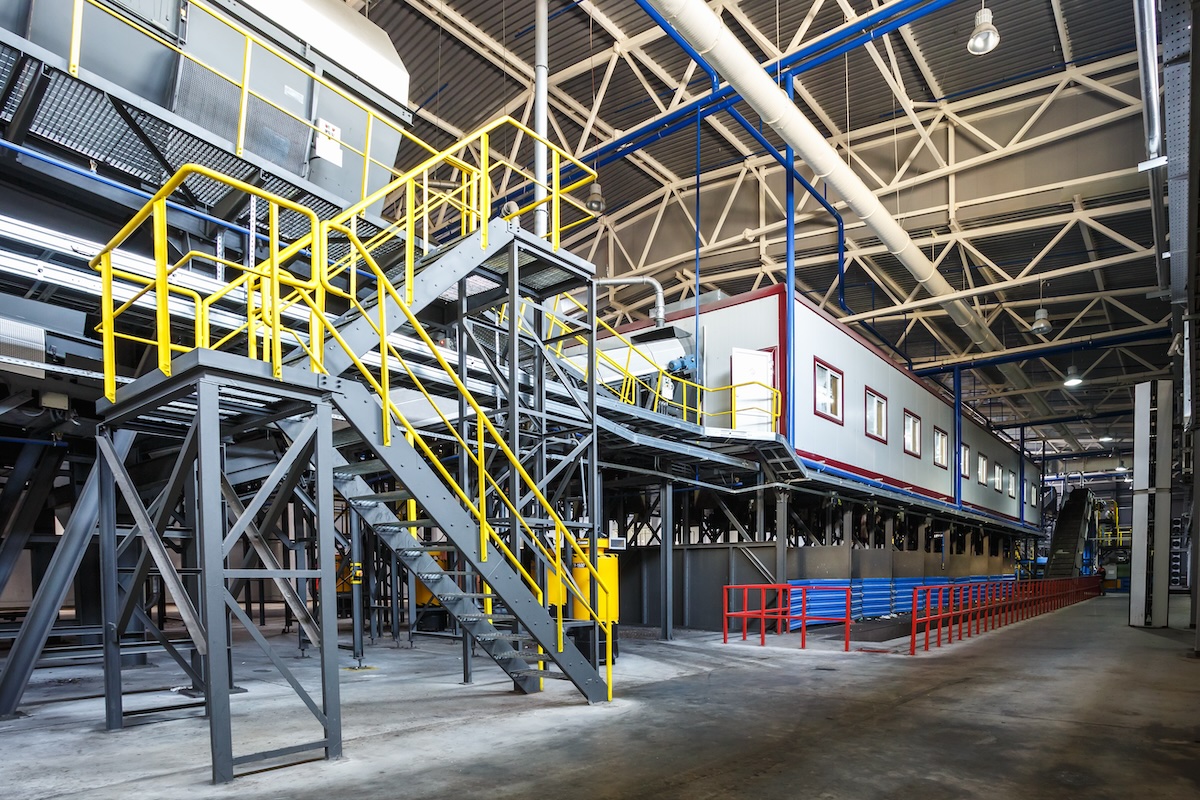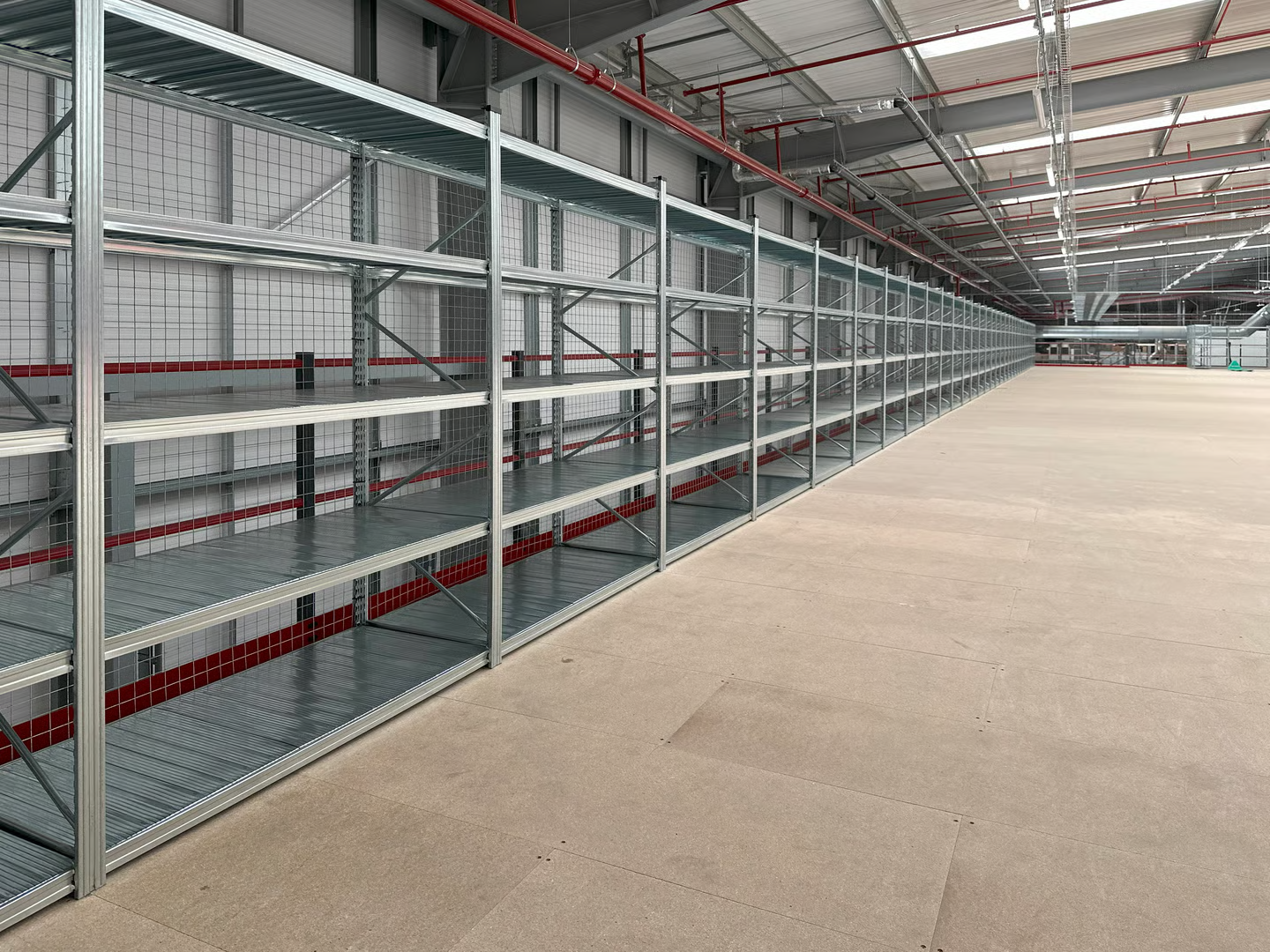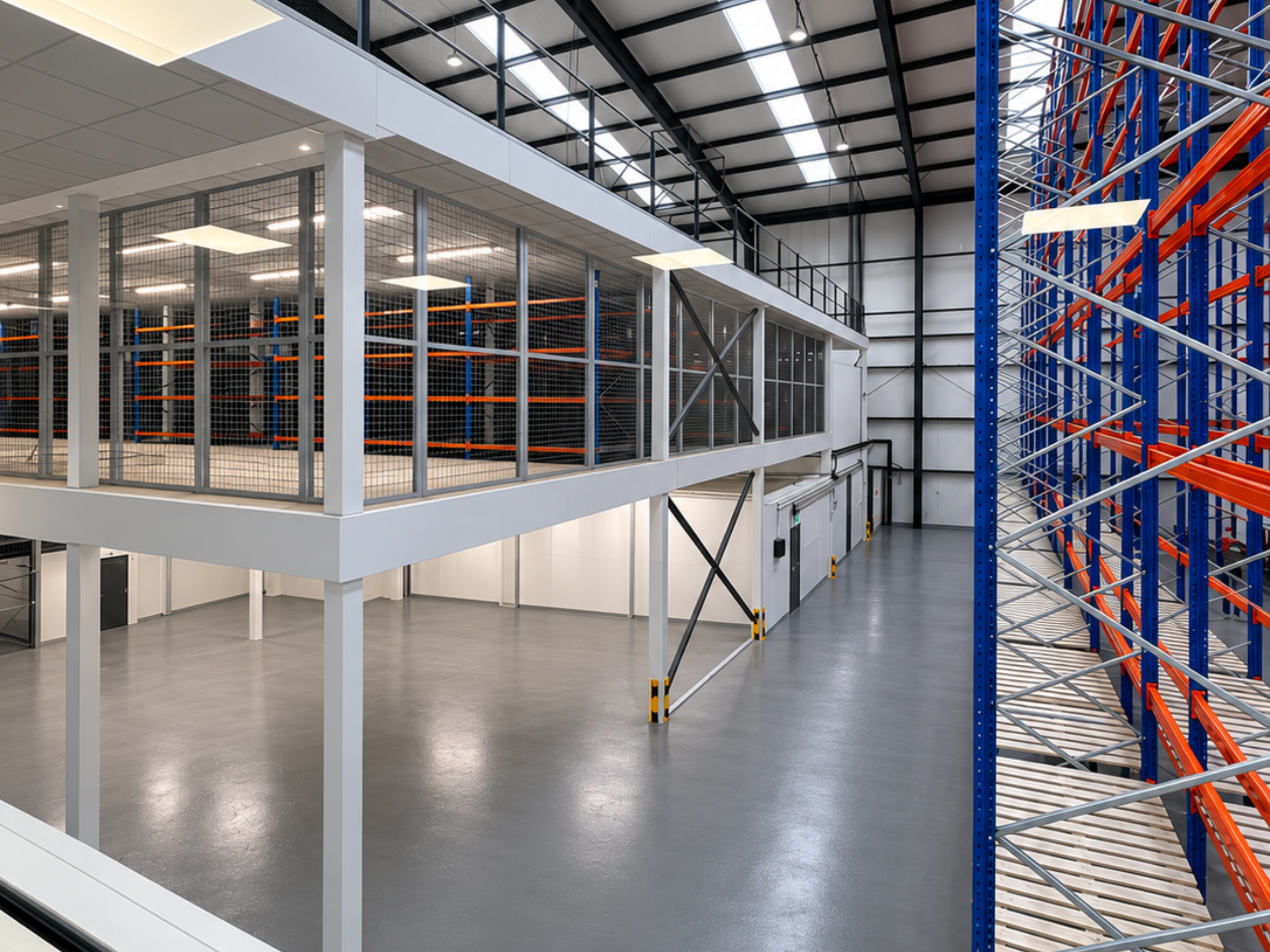
Mezzanine floors transform warehouses, distribution centres and industrial units by adding a second tier of usable space without the cost of a new building.
But that elevated platform also introduces a serious risk if the mezzanine isn’t built to the required safety standards: unprotected or poorly protected edges. Falls from height remain one of the leading causes of fatal workplace injuries in the UK, and exposed mezzanine floor edges present a high level of risk.
At The Mezzanine Company, we design and install various types of mezzanine floors from retail mezzanines to industrial mezzanines. While the mezzanine floors we install may differ in type, our commitment to safety remains consistent with every project and edge protection is no exception.
Here to explain more, this guide will run you through the dangers of unprotected mezzanine edges, what UK law requires, plus the practical solutions available, including handrails, safety barriers and pallet gates.
The Dangers of Unprotected Mezzanine Edges
A mezzanine floor typically sits between three and six metres above ground level. At that height, a fall is rarely minor. The consequences range from serious fractures to fatalities, and in industrial environments where workers may be moving quickly, carrying loads or operating near machinery, the risk is compounded.
The most common hazards at mezzanine edges include:
Falls By Pedestrians
Operatives working on the upper level may step back without realising an unguarded edge is close. In busy pick-and-pack or fulfilment environments, attention is on the task, not on spatial awareness.
Falls During Loading And Unloading
Mezzanine floors served by goods lifts or manual pallet transfer zones create a temporary gap in the edge protection every time a product is moved. Without a managed solution, that gap is an open hazard.
Falls Of Objects
Even where pedestrian falls are unlikely, boxes, pallets and equipment can fall from an unprotected edge onto workers below. Under UK health and safety law, this is treated as seriously as a fall of a person.
Visibility And Environmental Factors
Poor lighting, wet surfaces, forklift movements at lower levels, and the pace of warehouse operations all increase the likelihood that an edge incident turns into an injury.
What UK Law Requires
Edge protection on mezzanine floors is not optional. It is a legal requirement under several overlapping pieces of legislation.
The Work at Height Regulations 2005 are the primary piece of legislation governing work at height in the UK. Regulation 6 requires that work at height is properly planned and that any place of work at height is safe. Where a person could fall from height, the employer must provide collective protection measures, including guardrails, barriers or other physical controls, before relying on individual protection such as harnesses.
The Workplace (Health, Safety and Welfare) Regulations 1992 require that any surface from which a person could fall more than two metres must be suitably guarded. For mezzanine floors, this means the entire perimeter of the elevated platform must have appropriate edge protection in place at all times, including loading areas when not in active use.
BS EN ISO 14122 provides the technical standard for fixed access to machinery, including stairways, walkways and guardrails on elevated platforms. Part 3 of the standard covers guardrails and handrails and specifies minimum heights, load requirements and post spacing. Handrails on industrial mezzanines are typically required to be at least 1,100mm in height with an intermediate rail at approximately 500mm.
The HSE’s guidance on mezzanine floors also makes clear that loading areas (i.e. where goods are transferred to and from the upper level) require specific consideration. A static guardrail alone is not sufficient in a loading bay; a managed access solution, such as a pallet gate, is required to allow safe transfer of goods while maintaining protection at all other times.
Non-compliance carries real consequences. Prohibition notices, improvement notices and prosecutions under the Health and Safety at Work etc. Act 1974 lists all possible outcomes following an inspection or incident. Directors and managers can be held personally liable where failures are found to be serious or systematic.
Mezzanine Edge Protection Solutions
There is no single solution that suits every mezzanine application. The right combination of edge protection depends on how the platform is used, what goods are being handled and how people access the upper level.
Handrails And Guardrails
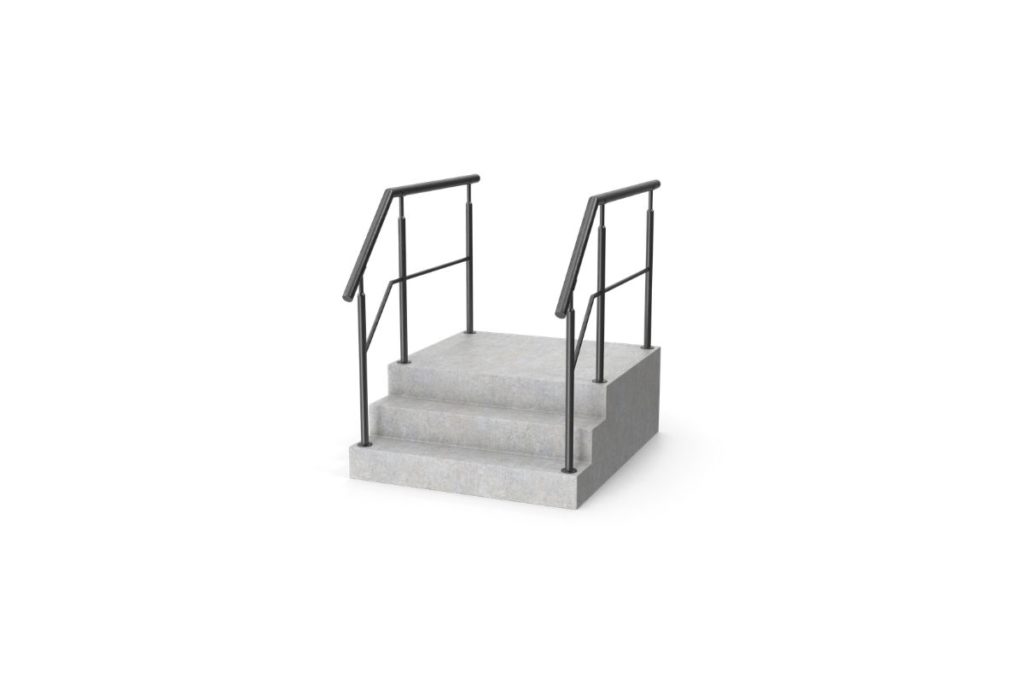
Handrails are the standard edge protection solution for the pedestrian perimeter of a mezzanine floor. They form a continuous barrier along walkways, stairway landings and open edges, and are typically manufactured from steel tube or box section, powder-coated for durability.
A compliant industrial handrail system consists of a top rail at or above 1,100mm, a knee rail at around 500mm and upright posts at regular intervals. The system must be capable of withstanding the lateral forces set out in BS EN ISO 14122, typically a minimum of 300N applied at the top rail.
Handrails are modular in most commercial systems, which means they can be configured around stairwells, lift openings and corners. Where the mezzanine perimeter changes frequently due to layout changes, bolt-down post systems allow adjustment without structural modification.
Safety Barriers
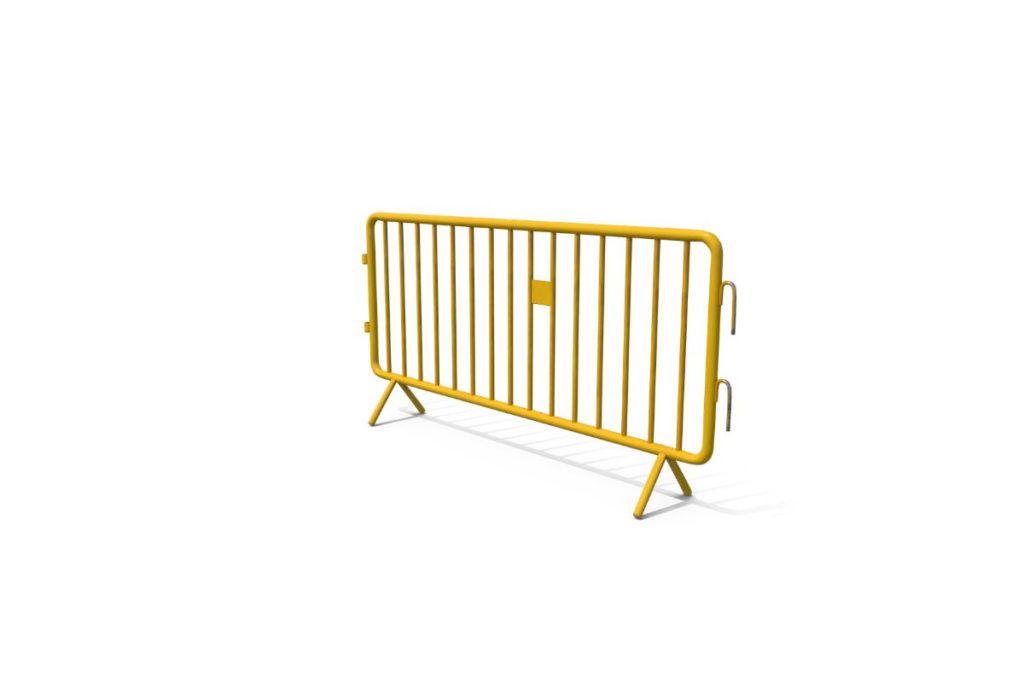
In environments where forklift trucks or other vehicles operate on or near the mezzanine, or where the edges of the floor are at risk of impact from goods handling activity, impact-rated safety barriers provide a higher level of protection than a standard handrail.
Safety barriers for mezzanine applications are typically manufactured from heavy-gauge steel and are designed to deflect or absorb impact rather than simply resist static force. They are floor-fixed with anchor bolts and can be supplied in modular sections to fit any edge length.
Some operators specify barriers at the base of mezzanine columns as well as along the edges, protecting the structural integrity of the platform from forklift damage. A barrier that prevents a vehicle from striking a column leg prevents potential structural failure, not just injury.
Pallet Gates
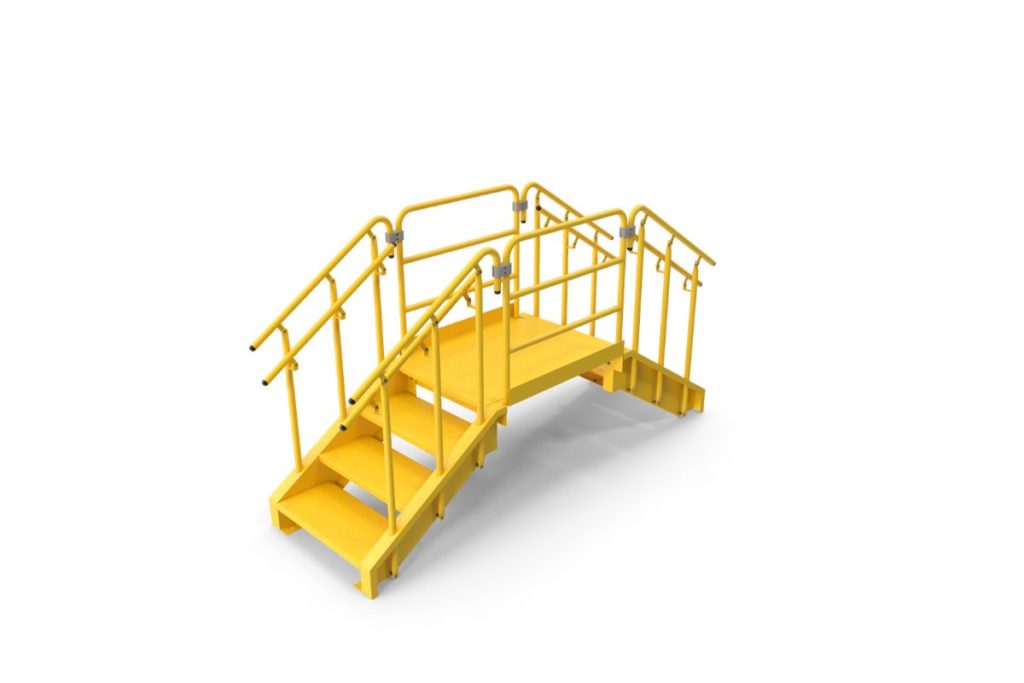
Pallet gates are the critical solution for loading areas: the point on the mezzanine floor where goods are raised or lowered by a goods lift, scissor lift or manually via a loading opening. They allow pallets and cages to be transferred to the upper level while ensuring the edge is never left open and unattended.
A pallet gate works on a counterbalanced, opposing-leaf principle. When the inner gate is open (to allow access to the goods), the outer gate is closed (blocking the edge). When the outer gate opens to receive or dispatch goods, the inner gate closes. The two leaves are mechanically or physically interlocked so that neither can be opened at the same time. This means there is always a barrier between a worker and the open edge, regardless of the stage of the loading cycle.
Pallet gates are available in various configurations to match the width of the loading opening and the height of goods being transferred. They are typically manufactured from tubular steel and can be supplied in single or double leaf designs, depending on the pallet gate opening width. Most are floor-mounted and column-mounted and can be integrated with the mezzanine handrail run on either side.
For operations running high throughput, powered pallet gate systems are available that open and close under pneumatic or electric control, reducing manual handling and improving cycle times at the loading bay.
Choosing The Right Edge Protection
A compliant mezzanine edge protection strategy generally combines all three solution types: handrails along the pedestrian perimeter, barriers in areas of vehicle exposure or high impact risk and pallet gates at every loading opening.
The starting point should always be a site-specific risk assessment. The assessment should identify every point where a person or object could fall from the mezzanine, map the pedestrian and vehicle traffic patterns on the upper level, and determine the load transfer method at each loading point. From that assessment, the right specification can be confirmed.
If you are commissioning a new mezzanine floor, edge protection should be designed into the structure from the outset, not added as an afterthought once the steelwork is in place. If you are reviewing an existing installation, a structural and compliance check will identify whether the current edge protection meets the requirements of the Work at Height Regulations 2005 and BS EN ISO 14122.
Getting edge protection right from the start is far less costly than dealing with a prohibition notice, a civil claim or, most importantly, a serious injury.
Get Your Mezzanine Edge Protection Specified Correctly With Help From Our Team
Whether you need handrails for a new installation, pallet gates for an active loading bay or impact barriers across a busy warehouse floor, we design and supply edge protection systems that meet the requirements of the Work at Height Regulations 2005 and BS EN ISO 14122.
Every project starts with a site assessment. We will identify every exposed edge, map your loading points and specify a compliant solution that works around your operation, not against it.
Get in touch with our team today to discuss your mezzanine edge protection requirements.
Or, for any help or advice relating to mezzanine floor installations in the UK, please give us a call on 0115 647 7425.